


Few class novels change a room the way Wonder does. R.J. Palacio’s story of August Pullman, a boy with a facial difference starting school for the first time, gets students talking about kindness, belonging and how we treat people who look different, often more honestly than any lesson on those topics could.
This guide gives you everything you need to teach it: a five-week reading plan, discussion questions for every part, activities, and a free printable novel study you can download below.
Why teach Wonder?
Wonder works in the classroom for three reasons. It’s genuinely gripping, so reluctant readers keep going. It’s told by several narrators, which makes it one of the best novels for teaching point of view. And it raises real questions about kindness and courage that students want to argue about.
It suits Years 4-7 (Grades 4-7) best. Older students get a lot from it too, especially when you focus on perspective and theme.
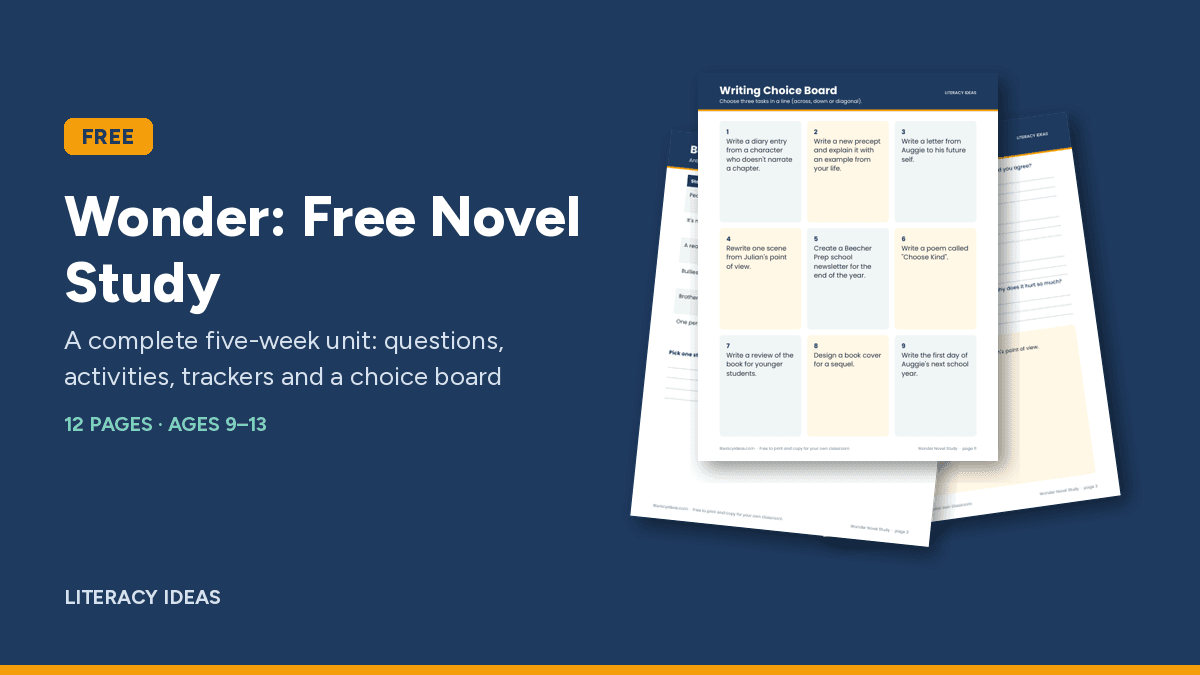
What’s in the free novel study
- A teacher overview with a five-week reading plan
- An anticipation guide to use before and after reading
- Four discussion questions and one activity for each week
- A character tracker and a theme tracker
- A vocabulary collector
- A nine-task writing choice board
- An after-reading reflection page
It doesn’t reproduce any text from the novel, so you’ll need copies of the book.
A five-week reading plan
The book is divided into eight parts, each named for its narrator. Here’s one way to group them across five weeks:
- Week 1: Part One (August). Auggie starts at Beecher Prep.
- Week 2: Parts Two and Three (Via, Summer). We see Auggie’s world through his sister and a new friend.
- Week 3: Parts Four and Five (Jack, Justin). A mistake, and how to make it right.
- Week 4: Parts Six and Seven (August, Miranda). Friendships are tested.
- Week 5: Part Eight (August). The nature retreat and the end of the year.
Big discussion questions
- Why do you think the author tells the story through several narrators? What would we lose if only Auggie told it?
- Which character changes the most, and what causes the change?
- Is it ever OK to be unkind because your friends are? What does Jack’s story suggest?
- What does it mean to choose kindness when you could choose being right?
- How does the school as a whole change by the end of the year?
Activities that work
Same event, different eyes
After each new narrator, pick one event students have already seen through Auggie’s eyes and ask: what did we get wrong about this character before we heard from them? It builds empathy and point-of-view skills at once.
Precept posters
Auggie’s English teacher gives the class a precept, or rule to live by, each month. Students write their own precept, explain it with an example from their life, and design a poster for the classroom wall.
Perspective writing
Students rewrite a scene from the point of view of a character who never narrates. It’s a great way to check whether they really understand each character’s motives.
Handling sensitive moments
Wonder includes bullying, including a cruel comment Auggie overhears at Halloween, and the death of the family dog. Read ahead, and give students space to talk about how it felt to read those parts. Many classes also use the book to set their own expectations for how they treat each other.
After reading
Finish with a writing task from the choice board, or use the novel for a full text response or book review. For a general framework you can use with any class novel, see our guide to running a novel study.
Take it further: Our Text Response Writing Unit teaches students to evaluate a novel and back their opinion with evidence. See the Text Response Writing Unit on TpT (paid resource).