


A robot washes up on a wild island and has to learn to survive among the animals, then ends up raising an orphaned gosling. Peter Brown’s The Wild Robot is short, beautifully illustrated and full of big questions, which makes it a wonderful class novel for younger readers.
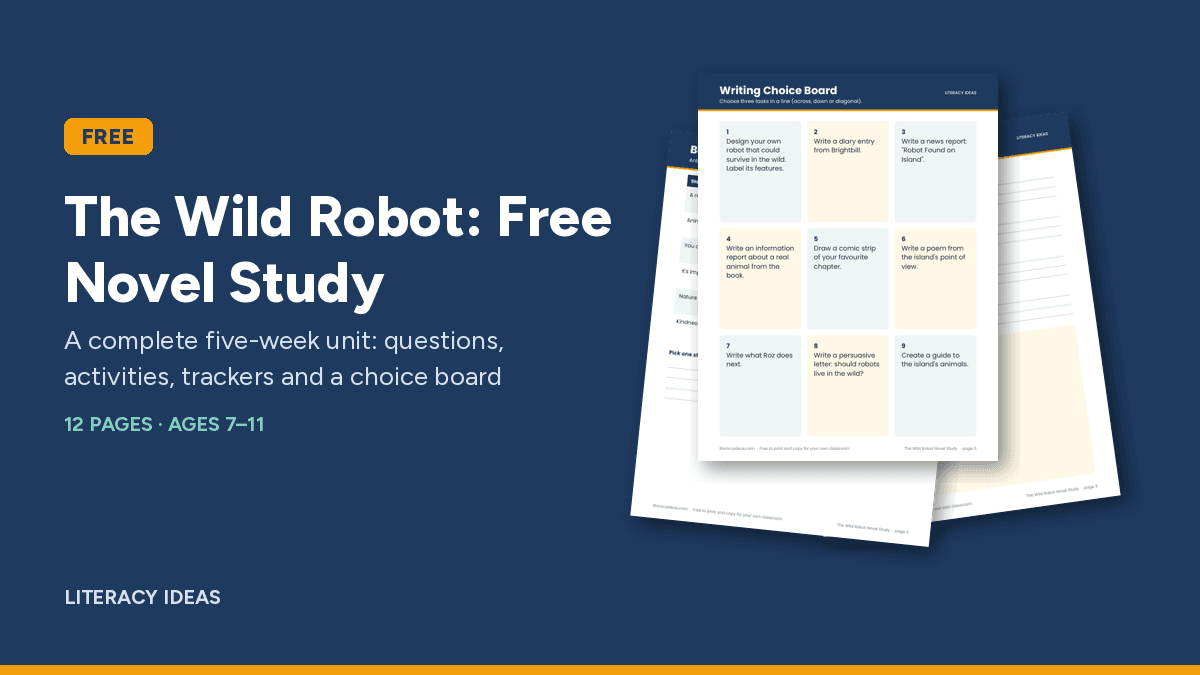
This guide gives you a five-week reading plan, discussion questions, activities, and a free printable novel study to download below.
Why teach The Wild Robot?
The chapters are very short, so it works for developing readers, but the ideas are big: what makes something alive, what makes a family, and how nature and technology fit together. For a generation growing up with smart devices and AI, it’s a story that sparks real debate.
It suits Years 2-5 (Grades 2-5) best, and works brilliantly as a read-aloud.
What’s in the free novel study
- A teacher overview with a five-week reading plan
- An anticipation guide to use before and after reading
- Four discussion questions and one activity for each week
- Character and theme trackers
- A vocabulary collector
- A nine-task writing choice board
- An after-reading reflection page
It doesn’t reproduce any text from the novel, so you’ll need copies of the book. The book has many short chapters, so the weekly sections are grouped by events. Adjust them to your pace.
A five-week reading plan
- Week 1: Roz arrives on the island and wakes up.
- Week 2: Roz becomes a mother to Brightbill.
- Week 3: Learning to fly, and the island’s seasons.
- Week 4: Spring, and strangers come to the island.
- Week 5: The final chapters: a choice and a goodbye.
Big discussion questions
- Is Roz alive? What makes you think so?
- How does Roz learn to survive? What does she copy from the animals?
- Can you be a family without being related?
- How do the animals’ feelings about Roz change, and why?
- Is Roz more of a robot or more of an animal by the end?
Activities that work
The class vote
Ask “Is Roz alive?” in the first week and again in the last, and keep a class tally. The shift in votes, and the reasons students give, show how deeply they’ve read. It also makes a great persuasive writing prompt.
Design a wild robot
Students design their own robot that could survive in the wild, labelling each feature and explaining what it’s for. It links neatly to science and design technology.
Animal reports
Students choose a real animal from the island and write an information report about it, comparing the real animal with how it behaves in the story.
Handling sensitive moments
Brightbill’s family dies early in the story, and robots are damaged in the final chapters. Both are handled gently, but younger readers may want to talk about them.
After reading
Use the choice board for creative writing, or try the book review page together. For a framework you can use with any novel, see our guide to running a novel study.
Take it further: Our Reading Skills Bundle has 19 resources for comprehension, vocabulary and fluency all year. See the Reading Skills Bundle on TpT (paid resource).