


Mood and tone are two of the slipperiest ideas we teach. Students mix them up, textbooks define them in ways that sound identical, and even confident readers freeze when asked “What’s the tone of this passage?” I spent years watching classes guess.
The good news is that once students have one clear way to tell them apart, and a bank of words to describe them, they get much better quickly. This guide gives you a simple analogy, short tone and mood word lists, three invented passages annotated for word choice, a three-lesson plan, and the link to author’s purpose. The full lists (120 words in all), six practice passages with answers and an organiser are in the free printable.
Mood vs tone: one simple way to tell them apart
Here’s the analogy I use: tone is the author’s voice, mood is the reader’s goosebumps.
Imagine a friend telling you about a terrible camping trip. The way they tell it, laughing, rolling their eyes, exaggerating every disaster, is their tone. It’s their attitude to the story. How you feel while listening, maybe amused, maybe a bit sorry for them, is the mood. Same story, two different things.
- Tone = the author’s (or narrator’s) attitude towards the subject. Ask: How does the writer feel about this?
- Mood = the feeling or atmosphere the reader experiences. Ask: How does this make me feel as I read?
Often mood and tone match: a writer with a gloomy tone creates a gloomy mood. But they can differ, and that’s where it gets interesting. A narrator might describe a dangerous situation in a calm, matter-of-fact tone, which makes the reader feel even more uneasy.
Tone word lists
Tone words describe attitude, so they often sound like ways a person might speak.
| Positive tone | Negative tone | Neutral or other tone |
|---|---|---|
| cheerful | bitter | formal |
| enthusiastic | sarcastic | matter-of-fact |
| admiring | critical | informative |
| hopeful | angry | serious |
| playful | mocking | curious |
| affectionate | impatient | reflective |
| encouraging | disapproving | nostalgic |
| humorous | pessimistic | urgent |
Mood word lists
Mood words describe atmosphere, so they often sound like the feeling of a place or moment.
| Light moods | Dark moods | Tense or other moods |
|---|---|---|
| joyful | gloomy | suspenseful |
| peaceful | eerie | tense |
| calm | lonely | mysterious |
| whimsical | menacing | anxious |
| cosy | bleak | chaotic |
| hopeful | sorrowful | restless |
| romantic | frightening | dreamy |
| festive | oppressive | exciting |
Notice that a few words, like hopeful, can describe either. That’s fine. What matters is the question being asked: the writer’s attitude, or the reader’s feeling?
Get the full mood and tone word lists
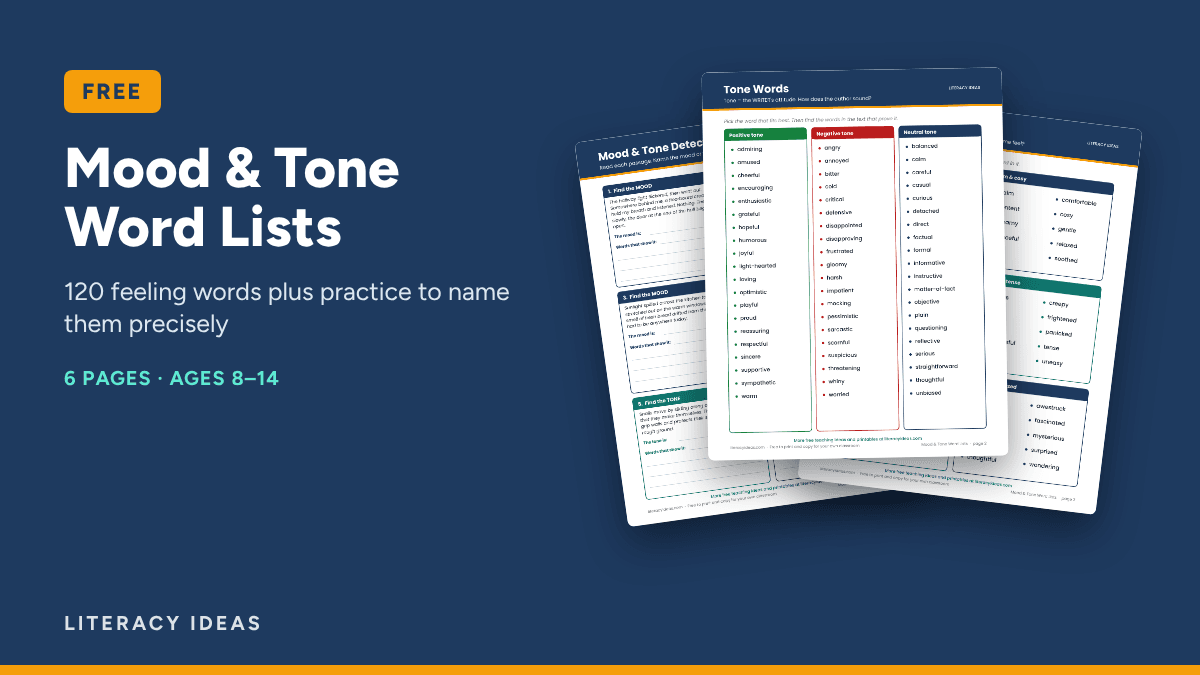
FREE: Mood & Tone Word Lists. 60 tone words and 60 mood words sorted into groups, 6 short practice passages with an answer key, and a word-choice organiser. 6 print-ready pages for ages 8 to 14: everything students need to stop saying “happy” and “sad” and start proving their answers. Pop in your email and the download link appears straight away.
Three annotated passages: from word choice to mood and tone
Students can’t name mood or tone by staring at a whole passage. They need to zoom in on specific words first, then zoom out. Each of these invented passages shows that process.
Passage 1: The old shed
The shed door groaned open. Inside, cobwebs sagged from every beam like grey curtains, and something small skittered behind the paint tins. The single window was so grimy that the afternoon light crept in thin and yellow, as if it didn’t want to be there either.
- Word choice: “groaned”, “sagged”, “skittered”, “grimy”, “crept”
- Figurative language: cobwebs “like grey curtains”; light that “didn’t want to be there” (personification)
- Mood: eerie, uneasy. The reader expects something unpleasant.
- Tone: wary and slightly dramatic. The narrator clearly doesn’t like this place.
Passage 2: Saturday pancakes
By eight o’clock the kitchen was a glorious mess. Flour dusted the bench, the radio was far too loud, and Dad was attempting his famous triple flip. It landed on the floor, of course. The dog was thrilled. Honestly, it was the best breakfast we’d had all year.
- Word choice: “glorious mess”, “famous triple flip”, “thrilled”, “best breakfast”
- Sentence style: short, punchy sentences that work like comic timing (“It landed on the floor, of course.”)
- Mood: warm, cheerful, cosy
- Tone: affectionate and humorous. The narrator gently teases Dad but clearly loves the moment.
Passage 3: The announcement
The school council has decided, once again, that students cannot be trusted with a longer lunch break. Apparently, the extra ten minutes we asked for would lead to total chaos. We are, after all, only the people who actually eat the lunch.
- Word choice: “once again”, “apparently”, “total chaos”, “after all”, “actually”
- Technique: saying the opposite of what’s meant, which is sarcasm
- Tone: sarcastic and frustrated
- Mood: amused or irritated, depending on whose side the reader is on
Passage 3 is the one that starts the best arguments. It shows students that the same tone can create different moods in different readers, which is exactly the kind of thinking we want.
How to teach mood and tone in 3 lessons
Lesson 1: Feel it first
Play three short pieces of instrumental music and have students write one word for how each makes them feel. That’s mood. Then read the same sentence aloud three ways: cheerful, bored, furious. Students name each attitude. That’s tone. Introduce the analogy and the two questions.
Lesson 2: Zoom in, zoom out
Model Passage 1 on the board. Highlight the strongest words, then ask what they have in common, then name the mood and tone. Students repeat the process in pairs with Passage 2. This is inference in action: clues first, then a conclusion.
Lesson 3: Change it
Students take a neutral sentence, such as “The girl walked into the empty classroom,” and rewrite it twice: once to create an eerie mood and once to create a cheerful one. They highlight the words they changed. This shows that mood is built on purpose through word choice, setting and figurative language. It pairs well with work on writing vivid settings.
How mood and tone connect to author’s purpose
Tone is one of the clearest windows into author’s purpose. A writer who wants to persuade often uses an urgent, passionate or critical tone. A writer who wants to inform usually sounds neutral, formal or matter-of-fact. A writer who wants to entertain might sound playful, humorous or suspenseful.
Ask students this sequence: What’s the tone? Why would the author choose that tone? What do they want me to think, feel or do? Once they can answer all three, they’re reading like writers. Mood and tone sit alongside character, setting and theme as key elements of literature, and they’re worth revisiting with every new text.
Want the full unit? My Author’s Purpose Unit has lessons, passages and organisers that help students explain why writers write the way they do, including how tone gives purpose away.
The writer’s toolkit: how authors build mood and tone
When students write their own pieces, give them a short checklist of the tools authors actually use. I keep this on the board during any descriptive writing lesson.
| Tool | What to try | Example |
|---|---|---|
| Verbs | Swap plain verbs for ones with feeling | “walked” becomes “crept”, “trudged” or “skipped” |
| Setting details | Choose details that match the mood | A flickering light, a dripping tap, a locked gate |
| Weather and light | Use the sky to set the atmosphere | “The fog swallowed the street lights one by one.” |
| Sentence length | Short sentences build tension; long ones slow things down | “Silence. Then a knock.” |
| Figurative language | Similes and personification carry feeling | “The wind whined at the window like a hungry dog.” |
Common mistakes with mood and tone
- Naming the topic instead of the tone. “The tone is about a shed” isn’t a tone. Fix: the answer must be an attitude word from the list.
- Guessing without evidence. Fix: no mood or tone word is accepted without at least two words from the text to back it up.
- Using only “happy” and “sad”. Fix: ban them and point to the word lists.
- Assuming mood and tone always match. Fix: use a passage like the sarcastic announcement above, where some readers feel amused rather than frustrated.
- Only teaching it with stories. Fix: include a news report, an advertisement and a letter, so students see that nonfiction has tone too.
Mood and tone FAQ
Can a text have more than one mood or tone?
Yes. Longer texts often shift. A story might start peaceful, turn tense in the middle, and end hopeful. Ask students to track the mood at the beginning, middle and end and find the words that signal each change.
Why do students confuse mood and tone?
Because the same words (hopeful, gloomy, serious) can describe both, and because mood and tone often match. Keep coming back to the two questions: “How does the writer feel about this?” and “How does this make me feel?”
Is tone the same as voice?
They’re close relatives. Voice is the writer’s overall personality on the page, which stays fairly consistent. Tone is their attitude to a particular subject, which can change from piece to piece. A writer with a chatty voice might still take a serious tone on a serious topic.
How do I teach mood and tone to younger students?
Focus on mood first, because feelings are easier to name than attitudes. Use picture books, music and colour (a gloomy grey page versus a bright yellow one). Start with simple words like happy, scary, calm and exciting, then build up to more precise ones.
What’s the best way to get students using more precise mood and tone words?
Ban the easy words. Once “happy”, “sad” and “scary” are off limits, students have to reach for cosy, bleak or menacing. Keep the word lists on desks and praise precise choices whenever you hear them.