


A boy wrongly sent to a camp with no lake, a family curse, and an outlaw from a hundred years ago. Louis Sachar’s Holes weaves three storylines together so cleverly that the ending makes students want to read it again, which is exactly why it’s such a good class novel.
This guide gives you a five-week reading plan, discussion questions, activities for tracking the clues, and a free printable novel study to download below.
Why teach Holes?
Holes is funny, mysterious and tightly plotted. Because the past and the present only connect at the end, it’s perfect for teaching plot structure, foreshadowing and how authors plant clues. It also opens up big discussions about fairness, friendship and injustice.
It suits Years 5-8 (Grades 5-8) best.
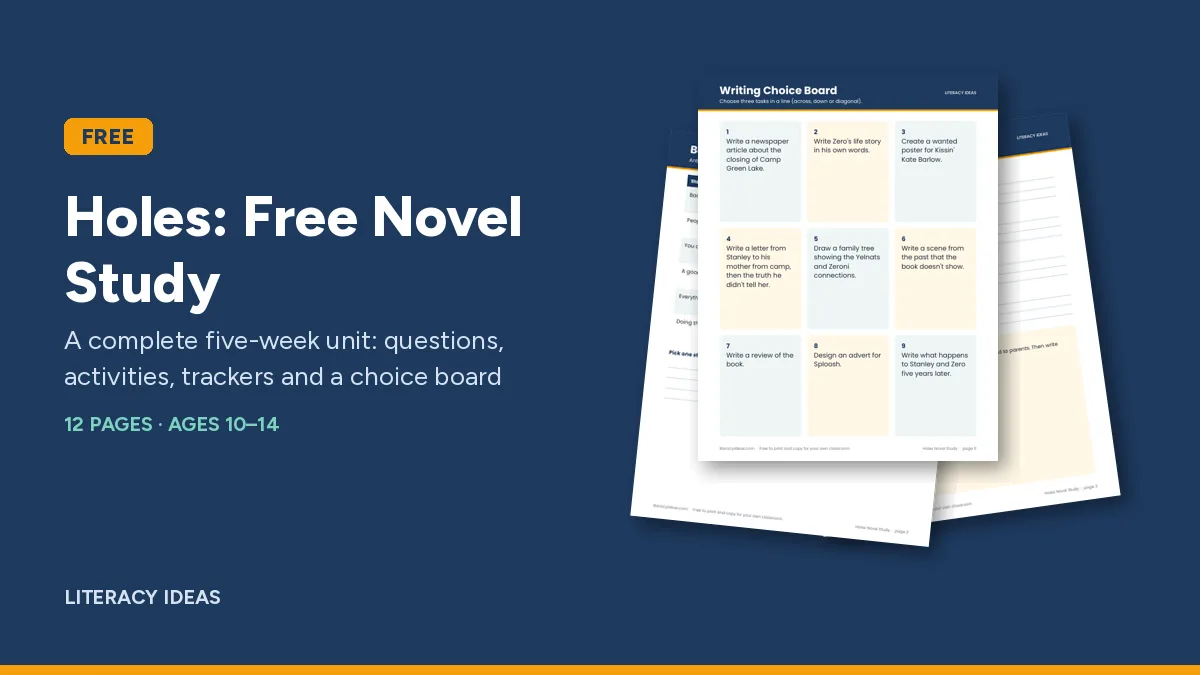
What’s in the free novel study
- A teacher overview with a five-week reading plan
- An anticipation guide to use before and after reading
- Four discussion questions and one activity for each week
- Character and theme trackers
- A vocabulary collector
- A nine-task writing choice board
- An after-reading reflection page
It doesn’t reproduce any text from the novel, so you’ll need copies of the book.
A five-week reading plan
- Week 1: Chapters 1-10. Arrival at Camp Green Lake.
- Week 2: Chapters 11-20. Digging, and a discovery.
- Week 3: Chapters 21-28. The past and the present begin to connect.
- Week 4: Chapters 29-40. Escape into the desert.
- Week 5: Chapters 41-50. The truth comes out.
Big discussion questions
- Is Stanley’s family really cursed, or are they just unlucky? Use evidence.
- Why does the town of Green Lake turn against Sam? What does this show about the town?
- How does the friendship between Stanley and Zero change both boys?
- Which storyline connection surprised you most at the end?
- Is the ending fair to everyone? Who gets justice, and who doesn’t?
Activities that work
The clue wall
Every time someone spots something that might matter later (a name, an object, a curse), it goes on a sticky note on the wall. By the final chapters, students race to connect the notes before the book does.
Two timelines
Students draw parallel timelines for the past and the present, then draw lines linking the events that connect. It makes the novel’s structure visible.
Plot mountain
Finish by plotting the whole novel on a story mountain. It’s a great way to teach how a complex plot still follows a clear structure.
Handling sensitive moments
The historical storyline includes racism and violence (the story of Katherine Barlow and Sam), and the boys at the camp are treated harshly. These chapters are worth slowing down for, and they lead to strong discussions about injustice.
After reading
Use the choice board for creative writing, or write a full book review. For a framework you can use with any novel, see our guide to running a novel study.
Take it further: Our Plot Diagram Unit has plot mountains and story structure tools for any book. See the Plot Diagram Unit on TpT (paid resource).