


The last week of the school year has its own strange energy. Reports are done, the classroom is half packed, and students can sense the finish line. It’s tempting to wheel out a film. But in my experience, the final week can produce some of the most honest, thoughtful writing of the whole year, if you give students something worth writing about.
And there’s nothing more worth writing about than the year they’ve just had. These end of year writing activities work whenever your school year finishes. You’ll find reflection prompts, a letter to next year’s class, a memory-book activity, goal setting, and a simple routine for the final week. There’s a free printable pack too.
End of year reflection prompts
Reflection works best when prompts are specific. “What did you learn this year?” gets a shrug. “What’s something you can do now that you couldn’t do on the first day?” gets a paragraph.
Looking back
- What’s one thing you can do now that you couldn’t do on the first day of the year?
- Describe a moment this year when you felt really proud of yourself.
- What was the hardest thing you did this year, and how did you get through it?
- Which piece of work would you show a visitor, and why?
- What’s a mistake you made that taught you something?
People and moments
- Who helped you most this year, and what did they do?
- Describe the funniest thing that happened in our classroom.
- If this year were a book, what would the chapter titles be?
- Write about one day this year you’d happily live again.
Choose two or three prompts per session rather than handing out the whole list. Students write more when they can choose but aren’t overwhelmed.
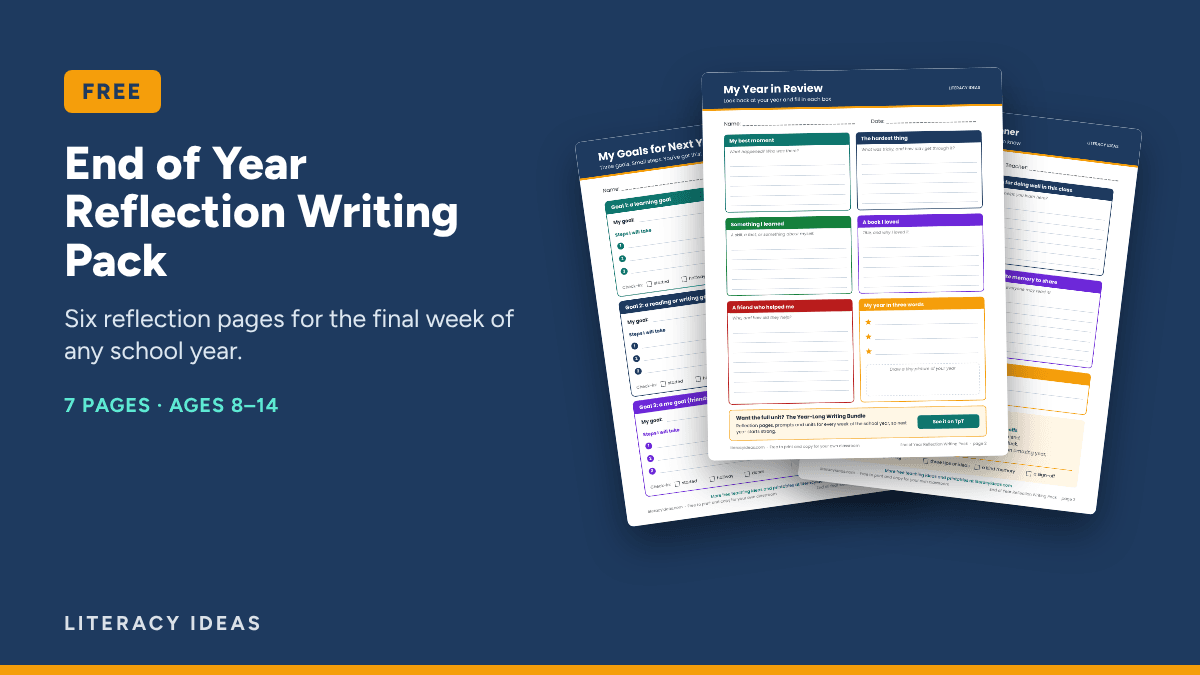
The letter to next year’s class
This is the activity students take most seriously, because they’re writing for a real audience. Each student writes a letter to a student who will sit in this classroom next year. Your current class are now the experts.
Give them a structure:
- Introduce yourself and say what this year was like in one sentence.
- Share three tips for doing well in this class.
- Describe a highlight they have to look forward to.
- Give one honest warning (kindly), such as “the spelling tests are real”.
- Sign off with encouragement.
Here’s an invented excerpt to share as a model: “Tip number two: don’t panic when you have to read your writing out loud. Everyone feels nervous the first time. By the end of the year I actually wanted to read mine first.”
Keep the best letters and put them on desks for your new class on day one. It’s a lovely bridge between years. For layout reminders, see my guide to writing a great letter.
Finding fresh writing activities every week takes time. If you’d rather start with something ready, our 25 Fun Writing Activities has 25 ready-to-go writing activities ($6.50 on TpT).
A memory-book style activity
A memory book doesn’t need to be a 20-page project. A simple folded booklet of six to eight pages works beautifully. Suggested pages:
- All about me now: age, favourite book, best subject, a self-portrait
- My best memory: a short personal recount of one moment from the year
- Our class in five words: five adjectives with a reason for each
- Autographs and kind words: classmates write one specific compliment each
- Top 5 lists: favourite lessons, books, lunchtime games, songs, jokes
- A note to my future self: to be opened in five years
The “best memory” page is a perfect mini personal narrative. Encourage students to zoom in on one small moment rather than summarise the whole year. My guide to writing a personal narrative has more on this.
Want the full unit? Get next year’s writing sorted before it starts. My Year-Long Writing Bundle covers every major text type with lessons, models and checklists, ready to teach from day one.
Goal setting for next year
End the year looking forward. Ask students to set three goals: one for learning, one for friendships or behaviour, and one just for fun. For each goal they write:
- What exactly they want to achieve
- Why it matters to them
- One step they’ll take in the first week back
Seal the goals in an envelope and pass them to next year’s teacher, or send them home. If your school does a mirror activity at the start of the year, these goals pair perfectly with my back to school writing activities. Students can compare the goals they set on day one with how far they’ve come.
How to run a final-week writing routine
The final week runs best with a predictable rhythm. Here’s the routine I used:
| Day | Writing focus | Time |
|---|---|---|
| Day 1 | Reflection prompts (choose two) | 30 minutes |
| Day 2 | Letter to next year’s class: plan and draft | 40 minutes |
| Day 3 | Memory book pages | 40 minutes |
| Day 4 | Goal setting and note to future self | 30 minutes |
| Day 5 | Share circle: students read one favourite piece aloud | 30 minutes |
Keep each session short and finish with sharing. If the energy is high, swap in one of these fun writing activities for a lighter day.
End of year writing FAQ
When should I start end of year writing activities?
In the last one to two weeks of the school year, whenever that falls for you. Starting too early can make students switch off from regular work, so save the reflection activities for the genuine final stretch.
Should I mark end of year reflections?
I wouldn’t give marks or scores. Reflection writing is personal, and students write more honestly when it isn’t marked. A short written comment or a conversation is far more valuable.
How do I adapt these for younger students?
Use sentence starters (“My favourite day was… because…”) and let students draw before they write. A memory book with one sentence and a picture per page is a great goal for younger writers.
What if a student had a tough year?
Offer choice. Let them focus on prompts about growth, people who helped, or goals for next year rather than highlights. Reflection should feel safe, not like a test of happiness.
Can these activities work for older students?
Yes. Older students can write deeper reflections, a more detailed letter with advice on study habits, and goals with measurable steps. The memory book can become a short reflective essay or a digital portfolio.
Ready to teach it? Get the 25 Fun Writing Activities on TpT ($6.50).