


Education quotes are short, memorable lines about teaching, learning and reading that teachers use to spark discussion, set a tone for the year and give students something worth thinking about. The catch is that a surprising number of the most shared ones were never said by the people they are pinned to.
So this collection is different. Every quote below has been checked against a real source: the original book, letter, speech or a trusted quote-checking archive. You will find around 70 verified quotes sorted by theme, a section on famous quotes people get wrong, and practical ways I use quotes in my classes, including six journal prompts you can use tomorrow.
Why I only use verified quotes
For years I had a poster on my classroom wall that said “Everybody is a genius” and credited Albert Einstein. A student asked me where Einstein said it. I couldn’t tell her, and when I looked, nobody else could either. It turns out there is no evidence he ever said it.
That moment changed how I use quotes. If we are teaching students to check sources, find evidence and question what they read online, our classroom walls should model it. A verified quote is also more interesting to teach: the real wording, the real speaker and the real context usually give you far more to talk about than the internet version. It is a natural link to information literacy and media literacy lessons, too.
Where a quote comes from a translation, I have named the translation. Where the popular wording differs from the original, I have used the original.
Verified education quotes by theme
Quotes about teaching
- “Men learn while they teach.” (Seneca, Moral Letters to Lucilius, Letter 7, trans. R. M. Gummere)
- “A teacher affects eternity; he can never tell where his influence stops.” (Henry Adams, The Education of Henry Adams, chapter “Failure”, 1907)
- “It is the supreme art of the teacher to awaken joy in creative expression and knowledge.” (Albert Einstein, plaque inscription for Pasadena Junior College, 1931, as translated in the Pasadena Star-News)
- “If a man keeps cherishing his old knowledge, so as continually to be acquiring new, he may be a teacher of others.” (Confucius, Analects 2.11, trans. James Legge)
- “For the mind does not require filling like a bottle, but rather, like wood, it only requires kindling.” (Plutarch, On Listening to Lectures, trans. F. C. Babbitt, 1927)
- “The best instruction is that which uses the least words sufficient for the task.” (Maria Montessori, The Discovery of the Child, 1948)
- “The children are now working as if I did not exist.” (Maria Montessori, The Absorbent Mind, 1949)
- “Kids don’t learn from people they don’t like.” (Rita Pierson, TED Talk “Every Kid Needs a Champion”, 2013)
- “Every child deserves a champion, an adult who will never give up on them.” (Rita Pierson, TED Talk, 2013)
- “Education, therefore, is a process of living and not a preparation for future living.” (John Dewey, My Pedagogic Creed, 1897)
- “Education is the fundamental method of social progress and reform.” (John Dewey, My Pedagogic Creed, 1897)
- “One child, one teacher, one book, and one pen can change the world.” (Malala Yousafzai, speech to the United Nations Youth Assembly, 2013)
- “Education is the most powerful weapon which you can use to change the world.” (Nelson Mandela, speech at Madison Park High School, Boston, 1990)
Quotes about learning
- “Learning without thought is labour lost; thought without learning is perilous.” (Confucius, Analects 2.15, trans. James Legge)
- “Is it not pleasant to learn with a constant perseverance and application?” (Confucius, Analects 1.1, trans. James Legge)
- “When you know a thing, to hold that you know it; and when you do not know a thing, to allow that you do not know it; this is knowledge.” (Confucius, Analects 2.17, trans. James Legge)
- “When I walk along with two others, they may serve me as my teachers.” (Confucius, Analects 7.21, trans. James Legge)
- “I am not one who was born in the possession of knowledge.” (Confucius, Analects 7.19, trans. James Legge)
- “All men by nature desire to know.” (Aristotle, Metaphysics, Book I)
- “For the things we have to learn before we can do, we learn by doing.” (Aristotle, Nicomachean Ethics, Book II)
- “The roots of education are bitter, but the fruit is sweet.” (Attributed to Aristotle by Diogenes Laërtius, Lives of the Eminent Philosophers)
- “Learning is not attained by chance, it must be sought for with ardour and attended to with diligence.” (Abigail Adams, letter to her son John Quincy Adams, 1780)
- “If I have seen further it is by standing on the shoulders of Giants.” (Isaac Newton, letter to Robert Hooke, 1675)
- “Experience keeps a dear School, but Fools will learn in no other, and scarce in that.” (Benjamin Franklin, The Way to Wealth, 1758)
- “I have been the whole day without eating, and the whole night without sleeping: occupied with thinking. It was of no use. The better plan is to learn.” (Confucius, Analects 15.30, trans. James Legge)
Quotes about reading and books
- “The more that you read, the more things you will know. The more that you learn, the more places you’ll go.” (Dr. Seuss, I Can Read With My Eyes Shut!, 1978)
- “Reading maketh a full man; conference a ready man; and writing an exact man.” (Francis Bacon, “Of Studies”, Essays)
- “Some books are to be tasted, others to be swallowed, and some few to be chewed and digested.” (Francis Bacon, “Of Studies”, Essays)
- “From a Child I was fond of Reading, and all the little Money that came into my Hands was ever laid out in Books.” (Benjamin Franklin, Autobiography)
- “Read much, but not many Books.” (Benjamin Franklin, Poor Richard’s Almanack, 1738)
- “From that moment, I understood the pathway from slavery to freedom.” (Frederick Douglass, Narrative of the Life of Frederick Douglass, chapter VI, 1845, on learning to read)
- “What an astonishing thing a book is.” (Carl Sagan, Cosmos, episode 11, “The Persistence of Memory”, 1980)
- “A book is proof that humans are capable of working magic.” (Carl Sagan, Cosmos, episode 11, 1980)
- “Literature is my Utopia.” (Helen Keller, The Story of My Life, chapter XXI, 1903)
- “And what is the use of a book,” thought Alice, “without pictures or conversations?” (Lewis Carroll, Alice’s Adventures in Wonderland, chapter I, 1865)
- “‘Classic.’ A book which people praise and don’t read.” (Mark Twain, Following the Equator, 1897)
- “Let us pick up our books and our pens. They are our most powerful weapons.” (Malala Yousafzai, UN Youth Assembly speech, 2013)
Quotes about writing
- “The difference between the almost right word and the right word is really a large matter; it’s the difference between the lightning bug and the lightning.” (Mark Twain, letter to George Bainton, 1888)
- “Either write things worth reading, or do things worth the writing.” (Benjamin Franklin, Poor Richard’s Almanack, 1738)
- “If you want to be a writer, you must do two things above all others: read a lot and write a lot.” (Stephen King, On Writing, 2000)
- “Reading is the creative center of a writer’s life.” (Stephen King, On Writing, 2000)
- “If you don’t have time to read, you don’t have the time (or the tools) to write.” (Stephen King, On Writing, 2000)
- “There is no agony like bearing an untold story inside you.” (Zora Neale Hurston, Dust Tracks on a Road, 1942)
- “If you find a book you really want to read but it hasn’t been written yet, then you must write it.” (Toni Morrison, speech to the Ohio Arts Council, 1981, as reported in the Cincinnati Enquirer)
- “Begin at the beginning,” the King said gravely, “and go on till you come to the end: then stop.” (Lewis Carroll, Alice’s Adventures in Wonderland, chapter XII, 1865)
- “It is not often that someone comes along who is a true friend and a good writer. Charlotte was both.” (E. B. White, Charlotte’s Web, 1952)
The Twain line about the “almost right word” is my favourite way into a lesson on word choice. Pair it with a sentence-upgrade task from our writing process guide, where students swap three “almost right” words for “right” ones and explain the difference.
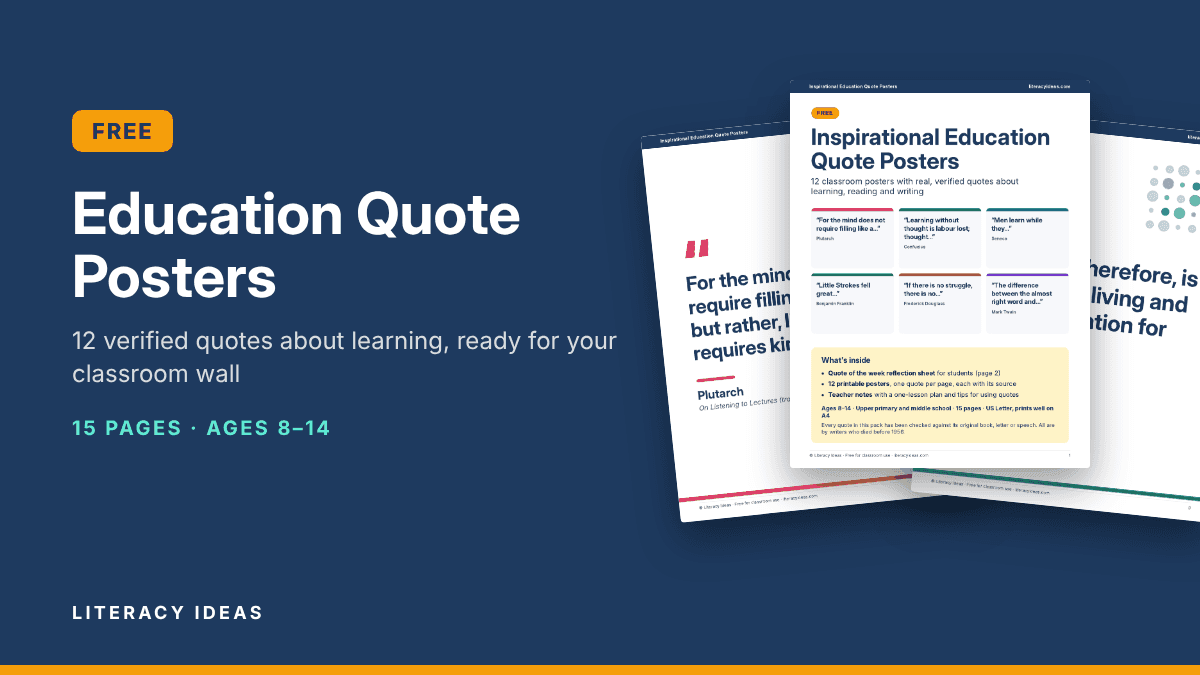
Get the free Inspirational Education Quote Posters
12 verified quote posters for your classroom wall. This free 15-page pack for students aged 8–14 has 12 print-ready posters, each with a real, sourced quote from writers like Plutarch, Confucius, Frederick Douglass and Mark Twain. It also includes a Quote of the week reflection sheet and teacher notes with a one-lesson plan.
Quotes about curiosity and questions
- “The important thing is not to stop questioning. Curiosity has its own reason for existence.” (Albert Einstein, quoted by William Miller in LIFE magazine, 1955)
- “I have no special talent, but am only passionately curious.” (Albert Einstein, letter to Carl Seelig, 1952)
- “Imagination is more important than knowledge. Knowledge is limited. Imagination encircles the world.” (Albert Einstein, interview with George Sylvester Viereck, The Saturday Evening Post, 1929)
- “I keep six honest serving-men (They taught me all I knew); Their names are What and Why and When And How and Where and Who.” (Rudyard Kipling, Just So Stories, 1902)
- “Curiouser and curiouser!” cried Alice. (Lewis Carroll, Alice’s Adventures in Wonderland, chapter II, 1865)
- “That depends a good deal on where you want to get to.” (The Cheshire Cat, in Lewis Carroll, Alice’s Adventures in Wonderland, chapter VI, 1865)
- “I do not open up the truth to one who is not eager to get knowledge.” (Confucius, Analects 7.8, trans. James Legge)
- “The silent treasuring up of knowledge; learning without satiety; and instructing others without being wearied.” (Confucius, Analects 7.2, trans. James Legge)
Kipling’s six serving-men are the 5Ws and H in poem form. I put them up next to our question chart and use them before research tasks, alongside the questioning ideas in 5 ways to improve critical thinking skills.
Quotes about mistakes and persistence
- “Ever tried. Ever failed. No matter. Try again. Fail again. Fail better.” (Samuel Beckett, Worstward Ho, 1983)
- “Marilla, isn’t it nice to think that tomorrow is a new day with no mistakes in it yet?” (L. M. Montgomery, Anne of Green Gables, chapter XXI, 1908)
- “Results! Why, man, I have gotten a lot of results! I know several thousand things that won’t work.” (Thomas Edison, as recalled by his colleague Walter Mallory in Edison: His Life and Inventions, 1910)
- “If there is no struggle, there is no progress.” (Frederick Douglass, “West India Emancipation” speech, 1857)
- “To have faults and not to reform them, this, indeed, should be pronounced having faults.” (Confucius, Analects 15.29, trans. James Legge)
- “One swallow does not make a summer, nor does one day.” (Aristotle, Nicomachean Ethics, Book I, trans. W. D. Ross)
- “Love your Enemies, for they tell you your Faults.” (Benjamin Franklin, Poor Richard’s Almanack, 1756)
- “We realize the importance of our voice when we are silenced.” (Malala Yousafzai, UN Youth Assembly speech, 2013)
- “If you tell the truth you don’t have to remember anything.” (Mark Twain, notebook entry, 1894)
These pair beautifully with our growth mindset writing activities. The Edison line is a good one to compare with the popular “10,000 ways that won’t work” version (see the section on quotes people get wrong below).
Short quotes for classroom walls
Wall quotes need to be readable from the back row, so short is best. All of these are under ten words.
- “Little Strokes fell great Oaks.” (Benjamin Franklin, The Way to Wealth, 1758)
- “Diligence is the Mother of Good luck.” (Benjamin Franklin, The Way to Wealth, 1758)
- “Lost Time is never found again.” (Benjamin Franklin, The Way to Wealth, 1758)
- “Men learn while they teach.” (Seneca, Letter 7)
- “Fail again. Fail better.” (Samuel Beckett, Worstward Ho, 1983)
- “Curiouser and curiouser!” (Lewis Carroll, 1865)
- “All men by nature desire to know.” (Aristotle)
- “Read much, but not many Books.” (Benjamin Franklin, 1738)
- “Literature is my Utopia.” (Helen Keller, 1903)
- “Education is the only solution.” (Malala Yousafzai, 2013)
- “Learning without thought is labour lost.” (Confucius, Analects 2.15)
If you are building a quote wall, it works well as part of a wider display. Our anchor charts guide has layout ideas that keep a wall readable rather than cluttered.
Quotes for the first day and the last day
First day of the year:
- “You have brains in your head. You have feet in your shoes. You can steer yourself any direction you choose.” (Dr. Seuss, Oh, the Places You’ll Go!, 1990)
- “You don’t know what’s going to happen through the day, and there’s so much scope for imagination.” (L. M. Montgomery, Anne of Green Gables, chapter IV, 1908)
- “A journey of a thousand li starts beneath one’s feet.” (Laozi, Tao Te Ching, chapter 64, a literal rendering of the line usually translated as “a journey of a thousand miles begins with a single step”)
- “Have you somewhat to do To-morrow, do it To-day.” (Benjamin Franklin, The Way to Wealth, 1758)
Last day of the year:
- “A teacher affects eternity; he can never tell where his influence stops.” (Henry Adams, 1907)
- “The more that you learn, the more places you’ll go.” (Dr. Seuss, I Can Read With My Eyes Shut!, 1978)
- “Begin at the beginning, and go on till you come to the end: then stop.” (Lewis Carroll, 1865)
- “If help and salvation are to come they can only come from the children, for the children are the makers of men.” (Maria Montessori, The Absorbent Mind, 1949)
For more first-week ideas, see our back to school writing activities and icebreaker activities.
Famous quotes people get wrong
These are some of the most shared “education quotes” online. Each one has a real story behind it, and that story makes a brilliant five-minute lesson on checking sources.
| The popular version | Usually credited to | What really happened |
|---|---|---|
| “Everybody is a genius. But if you judge a fish by its ability to climb a tree…” | Albert Einstein | No evidence Einstein said it. Quote Investigator traces the idea to an animal-school fable from 1898–99 and the exact wording to a 2004 self-help book. |
| “Education is not the filling of a pail, but the lighting of a fire.” | W. B. Yeats or Socrates | The idea comes from Plutarch’s essay On Listening to Lectures: the mind “does not require filling like a bottle, but rather, like wood, it only requires kindling.” |
| “Tell me and I forget. Teach me and I may remember. Involve me and I learn.” | Benjamin Franklin | No link to Franklin. A partial match appears in the writings of the Chinese philosopher Xunzi. Franklin’s name was attached in the 1980s. |
| “I have never let my schooling interfere with my education.” | Mark Twain | The novelist Grant Allen used the line several times before it was ever pinned on Twain. |
| “The man who does not read good books has no advantage over the man who can’t read them.” | Mark Twain | No evidence from Twain. Similar wording appears in 1910s sources; the Twain credit first shows up in 1945, decades after he died. |
| “We are what we repeatedly do. Excellence, then, is not an act, but a habit.” | Aristotle | Written by Will Durant in The Story of Philosophy (1926) as a summary of Aristotle’s ideas. |
| “We do not learn from experience… we learn from reflecting on experience.” | John Dewey | Not found in Dewey’s works. It is a paraphrase of his ideas about reflective thinking. |
| “An investment in knowledge pays the best interest.” | Benjamin Franklin | Not in Franklin’s papers. It first appears in Boston newspapers in 1848–49, long after his death. |
| “I have not failed. I’ve just found 10,000 ways that won’t work.” | Thomas Edison | The earliest version (1910) is “I know several thousand things that won’t work.” The “10,000” wording appears in 1982. |
| “Once you learn to read, you will be forever free.” | Frederick Douglass | A paraphrase. His real words describe reading as “the pathway from slavery to freedom”. |
A quick classroom activity: give students the popular version and the real source, then ask why the made-up version spread further. You will get a great discussion about memorable wording, famous names and why we trust things that “sound right”. It links neatly to fact and opinion work.
How to use quotes in the classroom
A quote on a wall is decoration. A quote that students talk about, write about and argue with becomes a lesson. Here are the four routines I come back to every year.
1. Quote of the week
Put one quote on the board on Monday and leave it there all week. On Monday, read it aloud and ask what it might mean. Midweek, ask students to spot it “in action” in a book, a game or the playground. On Friday, take a two-minute vote: agree, disagree or “it depends”. It costs almost no lesson time and builds a habit of thinking about ideas.
2. Journal prompts
Quotes make excellent quick-write starters because students have something to push against. Here are six ready-to-use prompts for students aged 8–14. Give five to ten minutes of quiet writing, then let a few volunteers share.
- Anne Shirley says tomorrow is “a new day with no mistakes in it yet”. Write about a mistake you made that taught you something. What would you do differently tomorrow?
- Seneca wrote, “Men learn while they teach.” Describe a time you taught someone else how to do something. What did you learn while teaching them?
- Kipling’s “six honest serving-men” are What, Why, When, How, Where and Who. Choose something you are curious about and write one question for each serving-man.
- Franklin said, “Little Strokes fell great Oaks.” What is your “great oak” this term? List three small strokes you could make each week to get there.
- Mark Twain said the right word is like lightning and the almost right word is like a lightning bug. Find a sentence you wrote this week and upgrade one word. Explain why the new word is “lightning”.
- Carl Sagan called a book “proof that humans are capable of working magic”. Which book has worked magic on you? What did it make you see, feel or believe?
Want more? Our writing prompts collection has plenty more starters sorted by text type.
Want a ready-made motivation wall? Our Growth Mindset Posters pair inspirational quotes with bright classroom-ready designs.
3. Debate starters
Some quotes are perfect for a quick “four corners” debate (strongly agree, agree, disagree, strongly disagree). Students move to a corner, then each corner has one minute to give its best reason. These work especially well:
- “Imagination is more important than knowledge.” Is it? Can you imagine well without knowing anything?
- “Kids don’t learn from people they don’t like.” Is this always true? Have you ever learned from someone you didn’t like?
- “Read much, but not many Books.” Is it better to read lots of different books or to reread a few great ones?
- “If there is no struggle, there is no progress.” Can people make progress when things are easy?
4. Analysing a quote
With older students I use a simple four-step routine that turns a one-line quote into a proper close-reading task. It practises the same skills as inference and author’s purpose.
Put it in your own words. Small actions, repeated, can bring down something huge.
What is the image? An axe chopping a tree one stroke at a time. The oak stands for any big goal.
Who said it, when and why? Franklin, in a 1758 almanac speech about hard work and saving money.
Agree, disagree or “it depends”? Give one example from your own life as evidence.
Step 3 is the one most students skip, and it is the one that matters most. Once they have seen how many famous quotes are wrongly credited, they become much sharper readers of everything else.
Common mistakes (and quick fixes)
- Trusting a quote image. A nice font and a famous face prove nothing. Fix: search the exact wording plus “Quote Investigator” or “Wikiquote” before you print it.
- Too many quotes on the wall. Twenty quotes become wallpaper. Fix: display one featured quote at a time and rotate it.
- Quotes with no discussion. Students rarely read a poster they have never talked about. Fix: introduce every new wall quote with a two-minute “what does it mean?” chat.
- Old wording left unexplained. Words like “dear”, “ardour” or “maketh” trip up younger readers. Fix: teach the tricky word first, then read the whole quote.
FAQ
What is the most famous quote about education?
Nelson Mandela’s “Education is the most powerful weapon which you can use to change the world” is probably the most quoted, and it is genuine: he said it to students in Boston in 1990. “Education is not the filling of a pail, but the lighting of a fire” is just as popular, but its real source is Plutarch, not Yeats.
Did Einstein really say “everybody is a genius”?
No. There is no evidence Einstein said or wrote the “fish climbing a tree” line. He did say “Imagination is more important than knowledge” (1929) and “The important thing is not to stop questioning” (reported in 1955), so use those instead.
How can I check if a quote is real?
Search the exact wording in quotation marks, then look for an original source: a book, letter, speech or interview with a date. Quote Investigator and the “sourced” sections of Wikiquote are good starting points. If the only sources are quote websites and images, treat it as unverified.
What are good short quotes for students?
Franklin’s “Little Strokes fell great Oaks”, Seneca’s “Men learn while they teach” and Beckett’s “Fail again. Fail better.” are short, true and easy to discuss. See the classroom walls list above for more.
Can I put famous quotes on classroom posters?
For a display in your own classroom, short quotes with clear attribution are widely used. If you plan to share or sell printables, stick to words by people who died long ago, or quotes from old public domain translations, which is why our free poster pack only uses quotes from writers who died before 1956.
More guides
- Writing prompts for students
- Growth mindset writing activities
- Information literacy for students
- Back to school writing activities
- The complete guide to teaching reading
- Free teaching resources
Ready to take it further? Get Growth Mindset Posters on TpT ($3.00).