


The best classroom decoration ideas are the ones that help students learn: a reading corner that pulls them in, word walls they actually use, and walls covered in their own writing rather than shop-bought posters. Good classroom design is about purpose first and looks second, and in a literacy-rich room almost everything on the walls should help students read, talk or write.
Below you’ll find the principles I’ve settled on after many years of setting up my own classrooms, 24 practical classroom decor ideas grouped by area, a start of year setup checklist, a “what to put up when” plan, ideas by age group and the mistakes I see most often. There’s also a free printable display pack so you can get the basics on the wall this week.
Four principles before you put anything up
Every teacher has stood in an empty classroom in the holidays with a roll of backing paper and a vague sense of panic. Before you start, these four ideas will save you time, money and a lot of staples.
1. Purpose over pretty
For every display, ask: what will a student do with this? Read it, use it during writing, add to it, or be proud of it? If the honest answer is “nothing, it just looks nice”, it is a candidate for leaving off the wall. A pretty room is pleasant. A useful room is pleasant and makes your teaching easier.
2. Student work over bought decor
Students look at their own work and their classmates’ work far more than they look at a laminated poster. A wall of genuine student writing tells everyone who walks in that this is a room where writing happens. It also costs nothing, and it changes all year.
3. Visual calm beats visual overload
There is some research behind this one. In a 2014 study published in Psychological Science, Anna Fisher, Karrie Godwin and Howard Seltman at Carnegie Mellon University taught 24 kindergarten children a series of short science lessons in a laboratory classroom, some with heavily decorated walls and some with sparse walls. The children spent more time off-task and scored lower on the lesson tests when the walls were heavily decorated (about 42% correct compared with 55%).
It was a small lab study with young children, and the researchers themselves said more work was needed in real classrooms and that they were not telling teachers to strip their walls bare. I treat it as a sensible nudge: keep the wall you teach from fairly calm, and make every display earn its place.
4. Build it with your students
The walls should not be finished on day one. Leave space, put up headings, and let the class fill the room over the first few weeks. Students use what they helped make, and they notice when it changes.
A simple layout for a literacy-rich classroom
Before decorating, sort out the zones. Here’s the basic layout I aim for, whatever the shape of the room. Your windows, doors and power points will bend it, but the logic stays the same.
The busiest displays go on the side and back walls, not the wall students face during teaching.
24 classroom decoration ideas that actually help learning
Zones and layout
- Label every zone in plain words. “Reading corner”, “Writing station”, “Library returns”. Labels are free environmental print, which matters most for younger readers and students learning English.
- Put supplies at student height. Clear tubs with a word and a simple picture on the front (pencils, glue, scissors) mean fewer interruptions and more independence.
- Create a writing station. A small table or shelf with paper in different sizes, sticky notes, envelopes, a stapler and a few mentor texts. Students who finish early have somewhere purposeful to go.
Reading corner ideas
- Display books face-out. Students choose books by their covers far more than by their spines. Even one face-out shelf or a rain gutter along the wall makes a big difference to borrowing.
- Sort books into labelled genre bins. Let students do the sorting. Arguing about whether a book is fantasy or adventure is a genuine literacy conversation.
- Add a “What we’re reading” board. Students write short recommendations on cards and pin them up. It turns the reading corner into a conversation, and it’s where my reluctant readers most often find their next book.
- Make it comfortable, not crowded. A rug, two or three cushions or low chairs and a lamp are enough. Seating for three to five readers is plenty for most rooms.
- Rotate a small “featured” shelf. Put out five or six books linked to your current unit, author or theme. Change it every fortnight so there’s always something new to notice. For ideas on what to do with those books, see my reading activities for any book.
Word walls and working walls
- Start the word wall almost empty. Put up the A–Z headers and add a few words a week, chosen with the class. A word wall full of words on day one is wallpaper. One that grows is a tool.
- Make it usable from the seats. Big, clear lettering and high-contrast colours. If students can’t read it from where they write, move it or enlarge it.
- Run a working wall for each unit. Four headings stay up all year: learning intention, success criteria, word bank and model text. Everything underneath is handwritten during lessons and replaced when the unit changes.
- Annotate the model text together. Put a short example on the working wall and mark it up with the class in a different colour: “Here’s the hook”, “Here’s a time connective”. Students will copy the structure, which is exactly what you want while they are learning it.
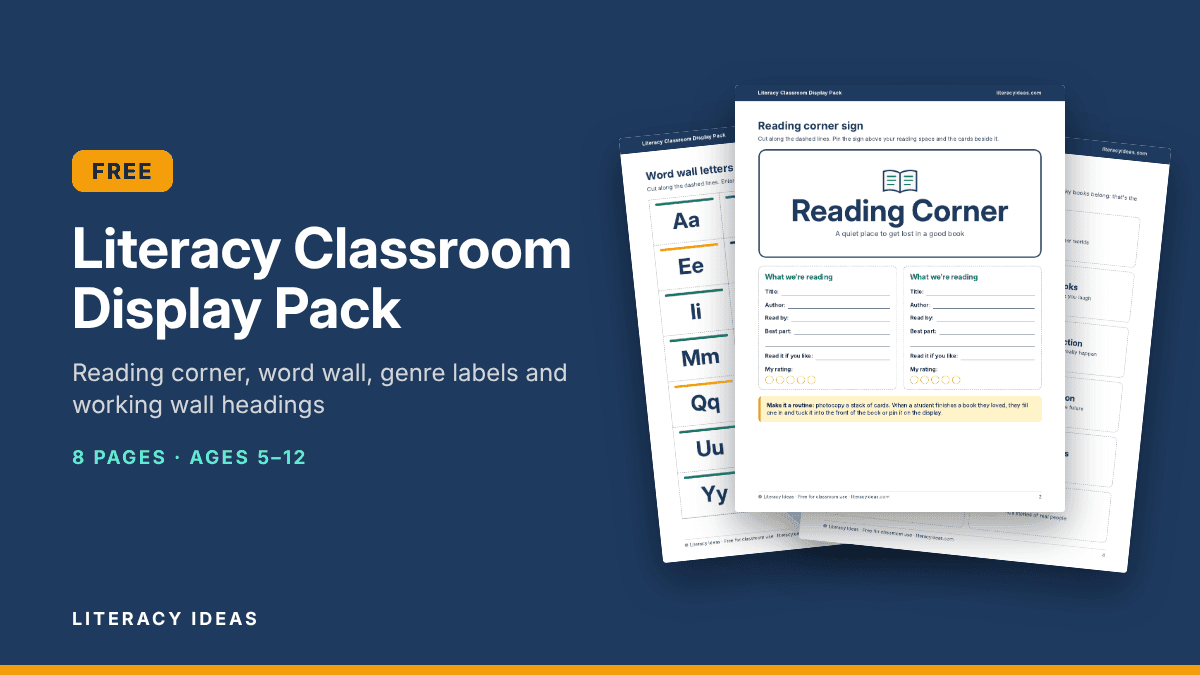
Get the free Literacy Classroom Display Pack
Get your literacy walls up this week. This free 8-page pack gives you a reading corner sign, A–Z word wall headers, 12 genre labels for book bins, writing display banners and working wall headings, all in a calm, uncluttered style for ages 5–12. It also includes a one-page classroom setup checklist and a first-week lesson where students build the reading corner with you.
Writing displays
- Use two boards: “Writing in progress” and “Our best writing”. Showing drafts, crossings-out and all, teaches students that writing is built in stages. Moving a piece from one board to the other is a small celebration. My guide to the writing process explains the stages if you want to label them.
- Add a “Wonder wall” of writing ideas. A space where students jot topics, questions and story ideas on sticky notes. When someone says “I don’t know what to write”, they go to the wall. Top it up with a few writing prompts if it runs thin.
- Display the text type you’re teaching. A narrative, a persuasive piece or a letter, with its structure labelled. Swap it when the unit changes. My overview of teaching writing covers the main text types.
Student work displays
- Give every student a “my best work” frame. A simple clip, peg or plastic sleeve with their name on it. They choose what goes in it and change it whenever they like. Nobody’s work is missing from the wall.
- Write a short caption for each display. One or two sentences that explain the task: “We wrote character descriptions using show, don’t tell.” Parents and visitors understand what they’re looking at, and students practise explaining their learning.
Anchor charts that earn their space
- Make anchor charts live, with the class. A chart you write together in front of students carries far more meaning than a printed one. Keep only the charts you’re currently using on the wall and file the rest in a big book students can flick through. There’s a full guide to making anchor charts if you want examples.
- Use a “retired charts” ring. Photograph old charts, print them small and put them on a ring or in a folder at the writing station. The knowledge stays in the room without filling the walls.
Interactive displays
- Try a “word of the week” with a twist. Post one rich word on Monday. Students who use it correctly in speech or writing add a tally or a sticky note with their sentence. Watch how quickly they start hunting for chances to use it.
- Put up a question board. A weekly question linked to your class novel (“Was the character right to lie?”) with space for sticky-note answers. It builds inference and opinion writing without a worksheet in sight.
Calm, low-cost and budget ideas
- Pick a calm colour scheme. Plain or neutral backing paper, with one or two accent colours, makes student work stand out instead of competing with it. Fabric backing lasts for years and doesn’t fade like paper.
- Spend on books and storage, not decor. Second-hand books from markets and library sales, plastic tubs and a few plants do more for a literacy classroom than a themed set of bought decorations.
Displays for older students
- Treat the walls like a magazine, not a nursery. Students aged 11 to 14 respond to displays that look grown up: a “currently reading” board with staff picks, quotes from novels they’ve studied, a vocabulary wall for subject terms and examples of writing from published authors next to their own. Let them design it, and you’ll get far more buy-in.
Start of year classroom setup checklist
This is the short version of the checklist in the free pack. Work through it before students arrive.
| Area | Check before day one | Leave for students to do |
|---|---|---|
| Layout | You can see every face from where you teach; clear paths to doors and bins | Agree on where bags, drink bottles and finished work go |
| Reading corner | Shelves, seating, good light, some books face-out | Sort books into genre bins; write the first recommendation cards |
| Word wall | A–Z headers up at a readable height | Choose and add the first words |
| Working wall | Four headings up, space left blank | Build the first learning intention and success criteria together |
| Writing displays | “Writing in progress” and “Our best writing” banners up | Fill them with their own work |
| Calm and access | Front wall fairly clear; exits and safety notices uncovered; a quiet spot ready | Help set rules for the reading corner and quiet spot |
What to put up when
The fastest way to an overloaded room is putting everything up in the first week. Here’s how I spread it out.
| When | What goes up | Why |
|---|---|---|
| Week 1 | Zone labels, visual timetable, reading corner sign, word wall headers, working wall headings, empty display banners, one or two class-made charts (such as class agreements) | Students need to know how the room works. The rest should come from them. |
| Weeks 2 to 4 | First student writing, first word wall words, “What we’re reading” cards, first unit’s model text and word bank | The room starts to belong to the class. Simple back to school writing activities give you plenty to display. |
| Rest of term 1 | Anchor charts made in lessons, “my best work” frames, question board, featured book shelf | Displays now track what you’re teaching. |
| Later terms | Swap working wall each unit, retire old charts to the ring, refresh student work every few weeks | Keeps the walls current and stops visual clutter building up. |
Want your literacy walls done for you? Our 120 English & Literacy Classroom Posters bundle covers parts of speech, homophones, narrative elements and more, in high-resolution files you can print at any size.
Quick classroom decor ideas by age group
| Age group | Ideas that work well |
|---|---|
| Ages 5–7 (early years) | Labels with words and pictures, a large alphabet with sounds, high-frequency word wall, name wall with photos, big-book stand in the reading corner, very calm front wall |
| Ages 8–10 (middle primary) | Genre bins sorted by students, working wall per unit, “Writing in progress” board, word of the week, book recommendation cards |
| Ages 10–12 (upper primary) | Question board for the class novel, vocabulary wall by subject, student-designed displays, editing checklists, author’s craft examples |
| Ages 12–14 (middle school) | Staff and student “currently reading” picks, quotes from studied texts, published writing next to student writing, minimal decoration |
Common classroom display mistakes (and quick fixes)
- Everything up on day one. Fix: put up headings and labels, and let students fill the space over the first month.
- Displays nobody uses. Fix: in week 4, stand at the door and take down anything students haven’t looked at or added to.
- Posters at adult eye level. Fix: sit in a student’s chair and check what you can actually read from there.
- Bright patterned backing paper everywhere. Fix: use plain or neutral backgrounds so the work is the colour.
- Work that stays up all year. Fix: set a reminder to refresh student work every three to four weeks, and send old pieces home or into a class book.
- A word wall that is just a list. Fix: refer to it in every lesson, play quick games with it, and expect students to use it when they spell.
FAQ
How do I decorate my classroom on a tight budget?
Use student work as your main decoration, plain backing paper or fabric, free printable headings and second-hand books. Spend any money you have on books and storage tubs first. A calm room with good books looks better than a themed room with few books.
Can a classroom be too decorated?
Yes. A small 2014 lab study with kindergarten children (Fisher, Godwin and Seltman) found they were more distracted and learned less in a heavily decorated room. It doesn’t mean bare walls are best, but it’s a good reason to keep the teaching wall calm and remove displays that no longer do a job.
What should go in a reading corner?
Books sorted into labelled bins, some displayed face-out, comfortable seating for a few readers, good light and a way for students to recommend books to each other. That’s all you need. Everything else is optional.
What is the difference between a word wall and a working wall?
A word wall collects useful words across the whole year, usually sorted A–Z. A working wall supports the unit you’re teaching right now, with the learning intention, success criteria, word bank and model text, and it’s replaced when the unit ends.
How often should I change classroom displays?
Working walls change with each unit. Student work should be refreshed every few weeks. Labels, the word wall headers and the reading corner sign can stay up all year.
More guides
- Anchor charts: how to make ones students use
- Back to school writing activities
- Reading activities for any book
- Icebreaker activities for the first week
- Free teaching resources
Ready to take it further? Get 120 English & Literacy Classroom Posters on TpT ($12.50).