


Bloom’s taxonomy is a way of sorting thinking into six levels, from remembering facts up to creating something new, so teachers can plan questions and tasks that stretch students beyond recall. In its revised form the six levels are remember, understand, apply, analyse, evaluate and create.
I have used it for most of my teaching career, mostly for one simple reason: it stops me asking thirty “who” and “what” questions in a row. Below you’ll find the levels explained in plain language, verb lists, question stems you can use with any book, a worked example, a planning grid, and a free printable pack of stem cards and bookmarks for students aged 8–14.
What is Bloom’s taxonomy?
In 1956 a committee of educators led by Benjamin Bloom published Taxonomy of Educational Objectives, a framework for classifying the goals teachers set for learning. The part most teachers know is the cognitive domain: thinking skills arranged from simpler to more complex.
The original six levels were nouns: knowledge, comprehension, application, analysis, synthesis and evaluation. In 2001 a group led by Lorin Anderson (a former student of Bloom’s) and David Krathwohl (one of the original authors) published a revised version. They made three changes that matter in the classroom:
- Nouns became verbs. “Knowledge” became “remember”, “comprehension” became “understand”, and so on, because the levels describe what students actually do.
- The top two levels swapped. “Synthesis” was renamed “create” and moved to the top, with “evaluate” just below it.
- Knowledge got its own dimension. The revision separates the kind of knowledge (factual, conceptual, procedural and metacognitive) from the thinking process applied to it.
Most classroom posters, including the ones in my free pack, use the revised version. That’s the one I’ll use for the rest of this guide.
Revised Bloom’s taxonomy (2001). Higher-order thinking sits at the top three levels.
The six levels at a glance
Here’s each level with what students actually do, some key verbs, and a sample question about a story almost every child knows: Goldilocks and the Three Bears.
| Level | What students do | Key verbs | Example question (Goldilocks) |
|---|---|---|---|
| Remember | Recall facts and details from the text | list, name, recall, identify | What three things did Goldilocks try in the bears’ house? |
| Understand | Explain ideas in their own words | retell, summarise, explain, describe | Retell the story in five sentences. |
| Apply | Use what they know in a new situation | use, show, demonstrate, solve | If Goldilocks walked into your classroom, what might she do first? |
| Analyse | Break ideas apart, compare, find patterns or causes | compare, sort, examine, organise | Why do you think the storyteller uses “too hot, too cold, just right” three times? |
| Evaluate | Make and defend a judgement using evidence | judge, justify, rank, recommend | Was Goldilocks wrong to go into the house? Give two reasons. |
| Create | Put ideas together to make something new | design, invent, compose, plan | Write the story again from Baby Bear’s point of view. |
Bloom’s taxonomy verbs for each level
Verb lists are handy for writing learning intentions and task instructions. Some verbs turn up at more than one level (for example “explain” or “compare”), because what matters is the thinking the task demands, not the word itself. More on that in the misconceptions section.
| Level | Verbs |
|---|---|
| Remember | list, name, recall, label, match, locate, identify, define, repeat, state, find, quote |
| Understand | explain, describe, retell, summarise, paraphrase, classify, give examples, interpret, outline, discuss, predict |
| Apply | use, show, demonstrate, solve, illustrate, act out, model, complete, carry out, relate, choose |
| Analyse | compare, contrast, sort, categorise, examine, organise, distinguish, infer, question, investigate, map, connect |
| Evaluate | judge, justify, critique, rank, rate, recommend, defend, decide, assess, argue, prioritise, check |
| Create | design, invent, compose, plan, construct, produce, devise, imagine, adapt, rewrite, propose, build |
Bloom’s taxonomy question stems for reading any book
This is the part I use every week. These stems work with picture books, chapter books, novels and short stories. Put a few on the board during guided reading, use them as exit tickets, or give each group a different level. I usually start a group at the level they are comfortable with and push them up one rung.
Remember
- Who are the main characters in this story?
- Where and when does the story take place?
- What happened at the very beginning?
- List three events in the order they happened.
- Find the sentence that tells you…
- What did ___ say when ___?
Understand
- Retell this chapter in your own words.
- What is the main problem in the story?
- Explain why ___ did ___.
- What do you think will happen next? What makes you think so?
- Describe how ___ feels at this point.
- What does the word ___ mean in this sentence?
Apply
- What would you have done if you were ___?
- Has something like this ever happened to you or someone you know?
- Draw or act out the most important scene.
- What advice would you give ___ right now?
- If this story happened in our town, what would change?
- Make a map or timeline that shows ___.
Analyse
- How is ___ different from ___? How are they alike?
- What caused ___ to happen? What was the effect?
- Which part of the story is the turning point? How do you know?
- What clues does the author give about ___?
- How does ___ change from the beginning to the end?
- Why do you think the author chose to ___?
Evaluate
- Do you agree with what ___ did? Why or why not?
- Which character made the best decision? Justify your choice.
- Was the ending satisfying? What makes you say that?
- Rate this book out of five and give three reasons.
- Would you recommend this book to a friend? Who, and why?
- What is the most important lesson in this story? Defend your answer.
Create
- Write a new ending for the story.
- Retell one scene from another character’s point of view.
- Invent a new character and explain how they would change the plot.
- Design a new cover and blurb for the book.
- Write a letter or diary entry from ___.
- Plan a sequel. What happens next?
If you’d like these as printable cards students can hold, they’re all in the free pack below. For more task ideas that work with any text, see my reading activities for any book.
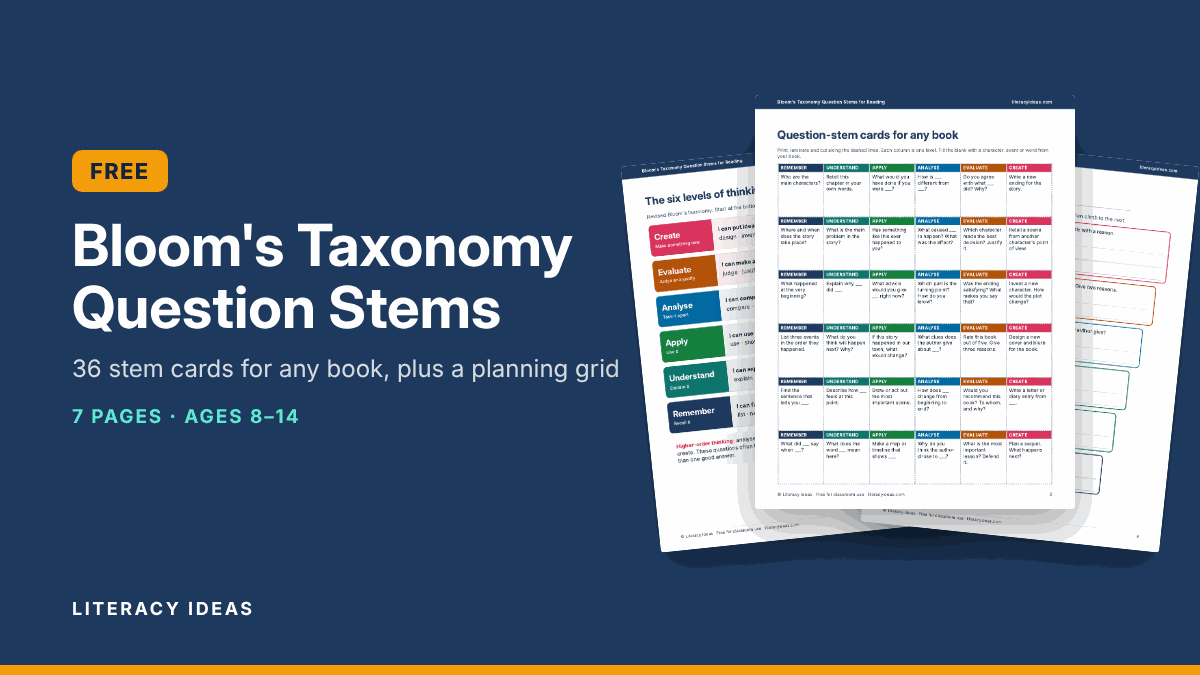
Get the free Bloom's Taxonomy Question Stems for Reading
Ask better questions about any book, at every level of thinking. This free 7-page pack for students aged 8–14 includes a six-level poster, 36 cut-out question-stem cards and two reading bookmarks. You also get a Bloom’s planning grid with an example row, a “climb the levels” response sheet and teacher notes for a one-lesson launch.
Higher-order and lower-order thinking
Teachers often split the taxonomy in two. Lower-order thinking covers remember, understand and apply. Higher-order thinking skills (often shortened to HOTS) cover analyse, evaluate and create.
The split is useful as a quick check on your own questioning. If I record the questions I ask in a guided reading session, it’s easy to see when I’ve spent twenty minutes on recall. But “lower” doesn’t mean less important. Students can’t compare two characters they can’t remember, and they can’t judge an argument they don’t understand. The lower levels are the foundation that makes the higher ones possible.
A good rule of thumb: make sure every lesson includes at least one task from the top three levels, and that students have what they need from the bottom three to tackle it. If you want more ideas for building this habit, I’ve written about ways to improve critical thinking skills.
Worked example: all six levels with one short story
Here’s a short story I wrote to show how one text can carry questions at every level. Read it with your class, then work through the table.
The Lighthouse Key
Mira’s grandfather kept the lighthouse on Gull Point, but this winter his knees were too stiff for the ninety-two steps. On the night of the big storm, the power failed across the village. From the kitchen window, Mira watched a fishing boat’s tiny light bobbing closer to the rocks. Grandad pressed a brass key into her hand. “The backup lamp,” he said quietly. “You know the way.” Mira had climbed those steps a hundred times, but never in the dark, and never alone. Halfway up, the wind screamed through a cracked window and she almost turned back. She counted the steps out loud instead. At the top, her fingers shook as she turned the key. The lamp hummed, then blazed. Far below, the little boat swung away from the rocks.
| Level | Question | What a strong answer looks like |
|---|---|---|
| Remember | How many steps are in the lighthouse? | Ninety-two. Found directly in the text. |
| Understand | Why did Grandad give Mira the key? | His knees were too stiff to climb, and someone had to light the backup lamp to warn the boat. |
| Apply | What could you do, like Mira, when you feel scared halfway through something hard? | Uses Mira’s strategy in a new situation, for example counting breaths before a performance or test. |
| Analyse | How does the author build tension in the middle of the story? | Points to the dark, being alone, the screaming wind and “almost turned back”, then the shaking fingers before the lamp lights. |
| Evaluate | Was it right for Grandad to send Mira alone? Justify your answer. | Takes a clear position and supports it, for example “Yes, because lives were at risk and she knew the way” or “No, because a child should not face a storm alone, he could have called for help.” |
| Create | Write the same night from the point of view of someone on the fishing boat. | A new piece that stays consistent with the story’s events but adds the boat’s perspective, such as fear, the dark coastline and the sudden light. |
Notice that the evaluate answer can go either way. At that level there isn’t one correct answer, only better and weaker justifications. That’s worth telling students directly, because many of them assume every question has a single right response.
Planning a lesson or unit with a Bloom’s grid
A Bloom’s grid (sometimes called a Bloom’s matrix) is simply a table with the six levels down one side and a few task columns across the top. Filling it in forces you to plan tasks at every level instead of relying on whatever comes to mind in the moment.
Here’s how I build one for a class novel or unit:
- Choose your columns. These might be characters, setting, plot and theme, or reading, writing, speaking and art.
- Write one task per cell. Start with the create row. It’s the hardest to write and usually the most fun for students.
- Check the verbs match the thinking. An “analyse” task should genuinely need comparison or cause and effect, not just finding a fact.
- Turn it into a choice board. Ask students to complete, for example, one task from each row, or any four tasks that include at least two from the top three levels.
Choice boards work beautifully for differentiation. Students who need more support can work through the lower rows first, while confident readers can start higher. Everyone still meets the same text and the same ideas.
Want to see a finished example? My Charlie and the Chocolate Factory page includes free novel tasks organised by Bloom’s levels, and the fun spelling activities page has a free Bloom’s spelling matrix. The free pack on this page includes a blank planning grid with one row filled in so you can see the pattern.
Want more Bloom’s-based tasks? My Bloom’s Taxonomy Spelling Activities turn any weekly word list into tasks at every level, from remembering to creating, with an editable matrix and task cards.
Common misconceptions about Bloom’s taxonomy
- “It’s a strict ladder students must climb in order.” Real thinking moves up and down. Writing a story (create) often sends students back to check facts (remember). You don’t need to finish all the remember tasks before anyone is allowed to evaluate.
- “Lower levels are bad teaching.” Recall and understanding are essential. The problem is only when a lesson never moves beyond them.
- “Using a higher-level verb guarantees deeper thinking.” It doesn’t. “Compare the two characters’ names” uses an analyse verb but only needs recall. Check what the task actually asks students to do in their heads.
- “Create tasks are just craft activities.” Making a poster isn’t automatically create-level work. It becomes create-level when students combine ideas into something new with a purpose, such as a new ending that still fits the characters.
- “Younger students can’t do higher-order thinking.” Five-year-olds can tell you which bear’s chair was best and why. The thinking is the same, the text and the language get simpler.
A short, honest note on criticisms
Bloom’s taxonomy is a planning tool, not a proven map of how the brain works. Critics point out that the levels overlap, that the order isn’t fixed (you can be creative before you fully understand something), and that it says little about knowledge itself, which is partly why the 2001 revision added a separate knowledge dimension. Some also worry that teachers treat the verbs as a checklist rather than thinking about the task.
I think those are fair points. I still use it because it is simple, students can understand it, and it reliably reminds me to ask better questions. Use it as a lens, not a rulebook.
Bloom’s taxonomy in the digital and AI era
Search engines and AI chatbots can now hand students remember-level and understand-level answers in seconds. That makes the top of the taxonomy more important, not less.
- Evaluate: Checking whether an AI answer is accurate, complete and fair is evaluate-level work. Ask students to find one thing the AI got right, one thing it missed, and one claim they need to check in another source.
- Analyse: Compare an AI summary of a chapter with the chapter itself. What did it leave out? Did it change the meaning?
- Create: Let students use a tool for ideas, then require them to produce something that clearly reflects their own choices, such as a story set in their own town.
These skills sit at the heart of information literacy, and they’re worth practising with any text, digital or printed.
A 3-lesson sequence for teaching students the levels
Students do better at higher-order questions when they know the levels exist. Naming them gives the class a shared language: “That’s a remember question, can you push it up to analyse?” This sequence suits students aged 8–14.
Lesson 1: Meet the six levels
Read a very familiar story aloud (a fairy tale works well). Ask six questions, one per level, and write each on a strip of paper. Show the levels poster from the free pack, then have pairs sort the strips onto the six levels. Discuss the ones that caused arguments, because those debates are where the real learning happens.
Lesson 2: Ask, don’t just answer
Give each group a short story or picture book and a set of question-stem cards. Groups write one question per level about their text, then swap with another group to answer. Finish by asking: which questions were the most interesting to answer? Students usually notice it’s the higher ones.
Lesson 3: Climb the levels independently
Students apply the levels to their own independent reading book using the “climb the levels” response sheet and bookmark. Collect the sheets and look at the evaluate and create answers: they show you quickly who can justify an opinion with evidence and who needs more modelling.
After this, keep the language alive. Pin the poster near your reading area and ask students to label the questions they write in reading journals.
Frequently asked questions
What are the six levels of Bloom’s taxonomy?
In the revised version (2001) the levels are remember, understand, apply, analyse, evaluate and create. The original 1956 version used knowledge, comprehension, application, analysis, synthesis and evaluation.
What is the difference between the original and revised Bloom’s taxonomy?
The revision changed the level names from nouns to verbs, renamed synthesis as create and placed it above evaluate at the top, and added a separate dimension for types of knowledge.
Which levels count as higher-order thinking?
Analyse, evaluate and create are usually called higher-order thinking skills. Remember, understand and apply are called lower-order, though they are still essential foundations.
Can you use Bloom’s taxonomy with young children?
Yes. Young children can compare, judge and invent when the text and language are simple. “Which bear’s bed would you choose and why?” is an evaluate question a five-year-old can answer.
How do I use Bloom’s taxonomy in spelling or other subjects?
Any subject works. For spelling, students might list words with a pattern (remember), sort them by rule (analyse) and write a short story using them (create). The free matrix on my spelling activities page shows how.
More guides
- Reading comprehension strategies
- Teaching inference
- How to teach guided reading
- Teaching story elements
- Point of view
Ready to take it further? Get Bloom's Taxonomy Spelling Activities on TpT ($4.95).