


A plane crash, a lake in the Canadian wilderness, and a 13-year-old with nothing but a hatchet. Gary Paulsen’s Hatchet has hooked reluctant readers for decades, and it’s one of the best class novels for teaching character change, resilience and the power of setting.
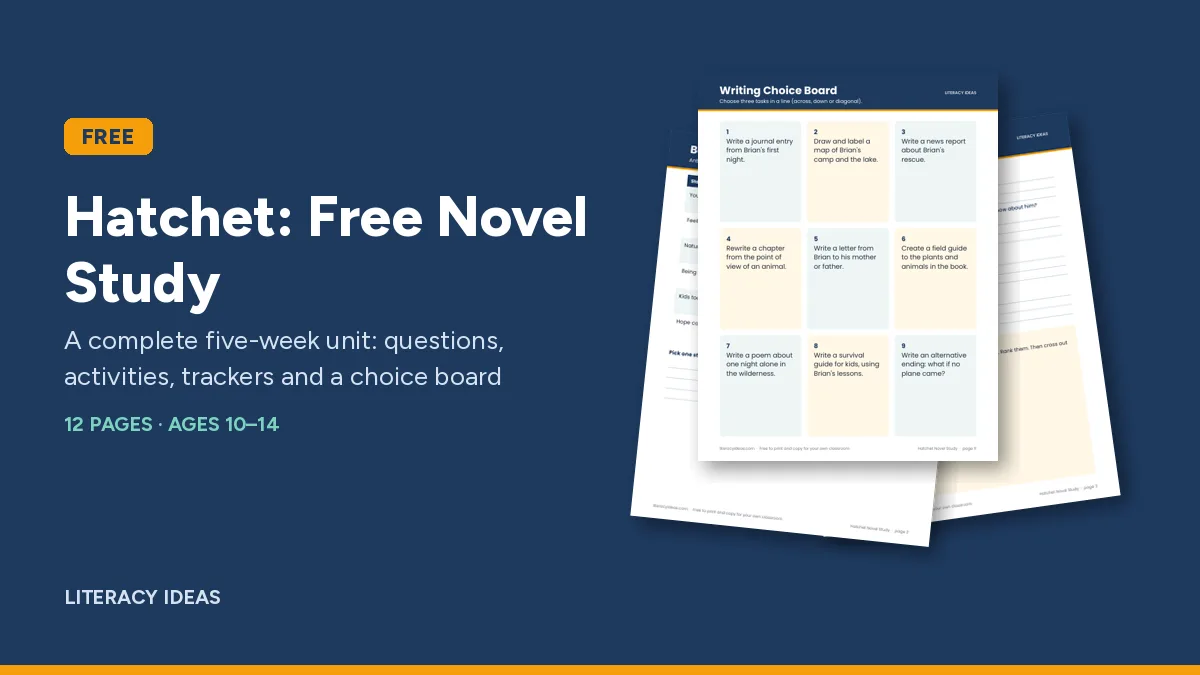
This guide gives you a five-week reading plan, discussion questions, activities that get students thinking like Brian, and a free printable novel study to download below.
Why teach Hatchet?
Hatchet is short, fast and full of tension, so students keep reading. Brian changes more than almost any character in middle-grade fiction, which makes it ideal for tracking character development. The wilderness setting is practically a second character, and the survival details lead naturally into science, geography and procedural writing.
It suits Years 5-8 (Grades 5-8) best.
What’s in the free novel study
- A teacher overview with a five-week reading plan
- An anticipation guide to use before and after reading
- Four discussion questions and one activity for each week
- Character and theme trackers
- A vocabulary collector
- A nine-task writing choice board
- An after-reading reflection page
It doesn’t reproduce any text from the novel, so you’ll need copies of the book. Section breaks are suggested and can be adjusted to your edition.
A five-week reading plan
- Week 1: Chapters 1-4. The flight, the crash and the first hours.
- Week 2: Chapters 5-8. Shelter, first food and first mistakes.
- Week 3: Chapters 9-12. Getting smarter, and the hardest moment.
- Week 4: Chapters 13-16. The new Brian: hunting, fishing and a dangerous encounter.
- Week 5: Chapters 17-19 and the Epilogue. The storm, the plane and rescue.
Big discussion questions
- Why does Brian decide that feeling sorry for himself doesn’t work? Do you agree?
- What does Brian learn from his mistakes? Which mistake taught him the most?
- How is the Brian at the end different from the Brian who got on the plane?
- Is the hatchet the most important thing Brian has? What else helps him survive?
- What does the epilogue add to the story?
Activities that work
The survival kit debate
Before reading, groups list ten items they’d want if they crashed in the wilderness, then argue their way to an agreed ranking. Then cross out everything except what Brian has. Students start the book already thinking like him.
Mistake journal
Students keep a running list of Brian’s mistakes and what each one taught him. By the end, it’s a powerful record of how he changed, and great evidence for an essay.
How-to guides
Students write a procedural text explaining one survival skill Brian learned, step by step. It’s a natural bridge from fiction to nonfiction writing.
Handling sensitive moments
The book includes the pilot’s death in the crash, Brian’s painful family secret about his parents’ divorce, and a chapter where Brian, in despair after a search plane misses him, harms himself. Read that chapter yourself first and decide how you’ll handle it. Many teachers use it to talk about hope and asking for help.
After reading
Use the choice board for creative writing, or turn the big questions into a full text response. For a framework you can use with any novel, see our guide to running a novel study.
Take it further: Our Literary Analysis Essay Unit takes students from evidence to a finished response about any novel. See the Literary Analysis Essay Unit on TpT (paid resource).