


A wacky wordie is a word puzzle where the way words are arranged on the page, their position, size, direction, colour or how many times they appear, spells out a well-known phrase or saying. Write the word MIND over the word MATTER and you have “mind over matter”. That is the whole game, and it is surprisingly addictive.
Wacky wordies are also called rebus puzzles, word pictures or picture word puzzles. I have used them for years as warm-ups, brain breaks and ice-breakers, and they are one of the few activities that get a whole class of students aged 8 to 14 talking at once. Below you will find the nine tricks behind almost every wordie, 60 original puzzles with answers (sorted Easy, Medium and Hard), ideas for using them in class and a free set of printable puzzle cards.
What is a wacky wordie (or rebus puzzle)?
A rebus is a puzzle that uses pictures, symbols, letters or the layout of words to stand for words or parts of words. The name comes from Latin, where rebus means “by things”. Wacky wordies are a text-only kind of rebus. Instead of drawing a picture of an eye for “I”, they play with the words themselves.
Every wordie hides a common phrase, idiom, saying or compound word. To solve one, you describe exactly what you can see, out loud, and then listen for a phrase you already know. If you see the word HEAD sitting over the word HEELS, you say “head… over… heels” and the answer pops out.
That is why wordies are so useful in a literacy classroom. Students have to read closely, think flexibly about word meanings and draw on their knowledge of idioms and figurative language. They are a quick, low-stakes way to build the kind of thinking we ask for in inference and critical thinking lessons.
The 9 tricks for cracking any wacky wordie
Nearly every wordie uses one or more of the tricks below. When my students get stuck, I ask them to run through the list like a checklist: “Is it about position? Size? Direction?” Usually one of the questions cracks it.
| Trick | What to look for | Example | Answer |
|---|---|---|---|
| Position | Where is one word sitting? Over, under, in, on, between, before, after or outside another. | LONG written over DUE | Long overdue |
| Size | Is a word big, small, tall, thin or growing? | WORLD written in tiny letters | It’s a small world |
| Direction | Is a word backwards, upside down, mirrored, going up or going down? | DNAH (HAND backwards) | Backhand |
| Repetition | Count! How many times does a word or letter appear? | WHEEL WHEEL WHEEL WHEEL DRIVE | Four-wheel drive |
| Missing letters | Which letters have gone? Is a word headless, endless, short or unfinished? | _HICKEN (CHICKEN without its head) | Like a headless chicken |
| Split and scrambled words | Is a word broken, spread out, split or jumbled up? | F A L L I N G with the letters drifting apart | Falling apart |
| Letters as sounds | Say the letters out loud. C = see, U = you, Y = why, I = eye, B = bee, T = tea, R = are. | I C U | I see you |
| Numbers and symbols | Say the numbers. 2 = to or too, 4 = for, 8 = ate, 1 = one or won. | 2 GOOD 2 B TRUE | Too good to be true |
| Colour and style | Is a word coloured, faded, bold or crossed out? | ENVY written in green | Green with envy |
Here is what each of those examples looks like as a real puzzle tile:
- LONGDUE
Position
Answer: Long overdue
- WORLD
Size
Answer: It's a small world
- DNAH
Direction
Answer: Backhand
- WHEEL WHEELWHEEL WHEELDRIVE
Repetition
Answer: Four-wheel drive
- _HICKEN
Missing letters
Answer: Like a headless chicken
- FALLING
Split and scrambled words
Answer: Falling apart
- I C U
Letters as sounds
Answer: I see you
- 2 GOOD2 B TRUE
Numbers and symbols
Answer: Too good to be true
- ENVY
Colour and style
Answer: Green with envy
Two quick tips I always give students. First, say what you see in full sentences: “The word FEELING is blue” leads straight to “feeling blue”. Second, small words matter. Over, under, in, on, after, between, too and for are hiding in a huge number of wordies.
60 wacky wordies with answers
All 60 puzzles below are original, and every answer is a common English idiom, saying or compound word that students are likely to meet in their reading. Tap “Show answer” under any tile to check your guess and see which trick it uses. Try to solve each one before you peek!
Easy wacky wordies (1 to 20)
Start here with younger students or anyone new to wordies. Each one uses a single trick.
- MINDMATTER
Show answer to puzzle 1
Mind over matter
MIND is written over MATTER.
Trick: Position
- HEADHEELS
Show answer to puzzle 2
Head over heels
HEAD sits over HEELS.
Trick: Position
- MANBOARD
Show answer to puzzle 3
Man overboard
MAN is over BOARD.
Trick: Position
- READING
Show answer to puzzle 4
Reading between the lines
READING sits between two lines.
Trick: Position
- DEAL
Show answer to puzzle 5
Big deal
DEAL is written very big.
Trick: Size
- TALK
Show answer to puzzle 6
Small talk
TALK is written very small.
Trick: Size
- STAND
Show answer to puzzle 7
Stand up
STAND reads upwards, from bottom to top.
Trick: Direction
- KCAP
Show answer to puzzle 8
Backpack
PACK is written backwards.
Trick: Direction
- TROUBLETROUBLE
Show answer to puzzle 9
Double trouble
There are two (double) lots of TROUBLE.
Trick: Repetition
- 4GIVE&4GET
Show answer to puzzle 10
Forgive and forget
4 sounds like “for”: 4GIVE = forgive, 4GET = forget.
Trick: Numbers
- GO 4 IT
Show answer to puzzle 11
Go for it
4 sounds like “for”.
Trick: Numbers
- C U L8R
Show answer to puzzle 12
See you later
C = see, U = you, L8R = later (L + eight + R).
Trick: Letters as sounds, Numbers
- Y WORRY?
Show answer to puzzle 13
Why worry?
The letter Y sounds like “why”.
Trick: Letters as sounds
- R U OK?
Show answer to puzzle 14
Are you OK?
R sounds like “are” and U sounds like “you”.
Trick: Letters as sounds
- GSEG
Show answer to puzzle 15
Scrambled eggs
The letters of EGGS are scrambled.
Trick: Split and scrambled words
- HEART
Show answer to puzzle 16
Broken heart
HEART is broken in two.
Trick: Split and scrambled words
- THINK
Show answer to puzzle 17
Think outside the box
THINK is written outside a box.
Trick: Position
- FEELING
Show answer to puzzle 18
Feeling blue
FEELING is coloured blue.
Trick: Colour and style
- SECOND
Show answer to puzzle 19
Split second
SECOND is split down the middle.
Trick: Split and scrambled words
- 9CLOUD
Show answer to puzzle 20
On cloud nine
The number 9 sits on CLOUD.
Trick: Position, Numbers
Get the free Wacky Wordies Puzzle Cards
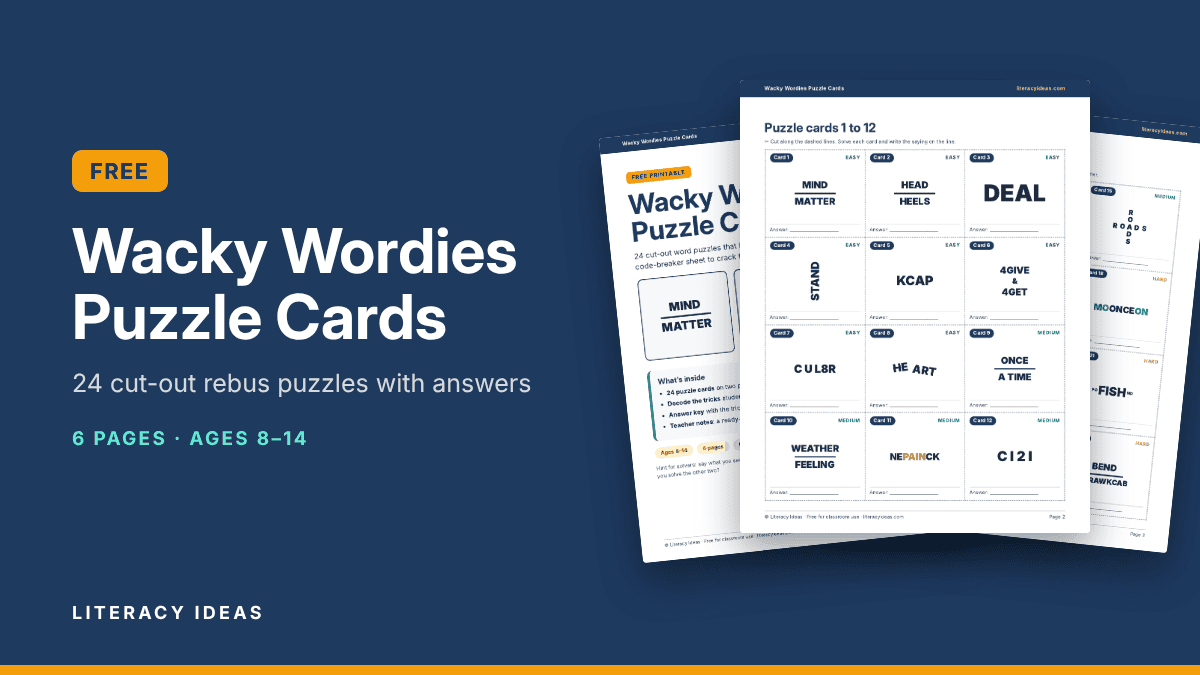
Free printable: 24 wacky wordies puzzle cards. A 6-page pack for ages 8–14 with two pages of cut-out puzzle cards (Easy, Medium and Hard), a “decode the tricks” student sheet and a full answer key. Teacher notes include a ready-to-run 40-minute lesson, and no email is needed: just download and print.
Medium wacky wordies (21 to 40)
These need a bit more thought. Some combine two tricks, and a few rely on knowing the idiom.
- ONCEA TIME
Show answer to puzzle 21
Once upon a time
ONCE sits upon A TIME.
Trick: Position
- WEATHERFEELING
Show answer to puzzle 22
Feeling under the weather
FEELING is under WEATHER.
Trick: Position
- HAHANDND
Show answer to puzzle 23
Hand in hand
HAND is written inside HAND (HA + HAND + ND).
Trick: Position, Repetition
- NEPAINCK
Show answer to puzzle 24
Pain in the neck
PAIN is inside NECK (NE + PAIN + CK).
Trick: Position
- WHIONCELE
Show answer to puzzle 25
Once in a while
ONCE is inside WHILE (WHI + ONCE + LE).
Trick: Position
- C I 2 I
Show answer to puzzle 26
See eye to eye
C sounds like “see”, I sounds like “eye” and 2 sounds like “to”.
Trick: Letters as sounds, Numbers
- T 4 2
Show answer to puzzle 27
Tea for two
T = tea, 4 = for, 2 = two.
Trick: Letters as sounds, Numbers
- 2 COOL4 SCHOOL
Show answer to puzzle 28
Too cool for school
2 = too, 4 = for.
Trick: Numbers
- TIMENO C
Show answer to puzzle 29
Long time no see
TIME is stretched long, and the letter C sounds like “see”.
Trick: Size, Letters as sounds
- TURN
Show answer to puzzle 30
No U-turn
The U in TURN is crossed out, so there is no U in the turn.
Trick: Missing letters
- IMAGE
Show answer to puzzle 31
Mirror image
IMAGE is written as if seen in a mirror.
Trick: Direction
- TABLES
Show answer to puzzle 32
Turn the tables
TABLES has been turned upside down.
Trick: Direction
- PAINS
Show answer to puzzle 33
Growing pains
The letters of PAINS grow bigger and bigger.
Trick: Size
- AWAY
Show answer to puzzle 34
Fading away
AWAY fades out letter by letter.
Trick: Colour and style
- WORD
Show answer to puzzle 35
Spread the word
The letters of WORD are spread out across the space.
Trick: Split and scrambled words
- MEREPEAT
Show answer to puzzle 36
Repeat after me
REPEAT comes after ME.
Trick: Position
- ROADSRODS
Show answer to puzzle 37
Crossroads
Two ROADS cross each other.
Trick: Position, Repetition
- MEAL
Show answer to puzzle 38
A square meal
MEAL is inside a square.
Trick: Position
- TALE
Show answer to puzzle 39
A tall tale
TALE is written very tall.
Trick: Size
- ICE
Show answer to puzzle 40
Break the ice
ICE is broken into pieces.
Trick: Split and scrambled words
Hard wacky wordies (41 to 60)
The tricky ones. Several of these combine tricks, and the answers are longer sayings. Great for early finishers and for adults in the staffroom.
- NEW LEAF
Show answer to puzzle 41
Turn over a new leaf
NEW LEAF has been turned over (upside down).
Trick: Direction
- MOONCEON
Show answer to puzzle 42
Once in a blue moon
ONCE is inside MOON, and MOON is blue (MO + ONCE + ON).
Trick: Position, Colour and style
- COOKCOOKCOOKCOOKCOOKCOOKCOOKCOOKCOOKBROTH
Show answer to puzzle 43
Too many cooks spoil the broth
There are lots (too many) of COOKs, and BROTH is crossed out (spoiled).
Trick: Repetition, Missing letters
- PAANTSNTS
Show answer to puzzle 44
Ants in your pants
ANTS is inside PANTS (PA + ANTS + NTS).
Trick: Position
- CCCCCCC
Show answer to puzzle 45
The seven seas
There are seven Cs, and C sounds like “sea”.
Trick: Letters as sounds, Repetition
- SENSE SENSE SENSESENSE SENSE SENSE
Show answer to puzzle 46
A sixth sense
There are six SENSEs, and the sixth one stands out.
Trick: Repetition, Colour and style
- ABCDEFGHIJKLMNOPQRSTVWXYZ
Show answer to puzzle 47
Missing you
The whole alphabet is there except U (“you”).
Trick: Missing letters, Letters as sounds
- HEART
Show answer to puzzle 48
Half-hearted
Only the top half of HEART is there.
Trick: Missing letters
- POFISHND
Show answer to puzzle 49
A big fish in a small pond
A big FISH is inside a tiny word POND (PO + FISH + ND).
Trick: Size, Position
- TAESDRIVER
Show answer to puzzle 50
Backseat driver
SEAT is written backwards (TAES), followed by DRIVER.
Trick: Direction
- DOWNEARTH
Show answer to puzzle 51
Down to earth
The letters of DOWN step down towards EARTH.
Trick: Direction, Position
- LEEFNIGS
Show answer to puzzle 52
Mixed feelings
The letters of FEELINGS are all mixed up (LEEFNIGS).
Trick: Split and scrambled words
- AUPIR
Show answer to puzzle 53
Up in the air
UP is inside AIR (A + UP + IR).
Trick: Position
- BATTLE
Show answer to puzzle 54
An uphill battle
BATTLE climbs uphill, letter by letter.
Trick: Direction
- BREAT
Show answer to puzzle 55
Short of breath
BREATH is one letter short: BREAT.
Trick: Missing letters
- MY HEART
Show answer to puzzle 56
Cross my heart
MY HEART has a big cross through it.
Trick: Colour and style
- MILLI1ON
Show answer to puzzle 57
One in a million
The number 1 is inside MILLION (MILLI + 1 + ON).
Trick: Position, Numbers
- BUSINE
Show answer to puzzle 58
Unfinished business
BUSINESS stops before it is finished: BUSINE.
Trick: Missing letters
- BENDSDRAWKCAB
Show answer to puzzle 59
Bend over backwards
BEND is over BACKWARDS, and BACKWARDS is written backwards.
Trick: Position, Direction
- ★ ★ ★SLEEPING
Show answer to puzzle 60
Sleeping under the stars
SLEEPING is under the stars.
Trick: Position
Want even more? Our collection of riddles to challenge your students includes another set of wordies and a free make-your-own-wordie pack.
How to use wacky wordies in the classroom
Wordies take seconds to set up and work with almost any age group. These are the ways I use them most.
Morning warm-ups
Put one or two wordies on the board as students arrive. It settles the room, gets brains switched on and gives early arrivals something purposeful to do. I keep the answer hidden until the roll is marked, then let a student who solved it explain how. That explanation is the valuable part: they have to name the trick and say what they noticed.
Ice-breakers
In the first week, or with a new group, give each table a set of puzzle cards and a time limit. Students have to talk, share guesses and laugh at the wrong ones, which is exactly what an ice-breaker should do. For more ideas, see these activities to break the ice with your students.
Vocabulary and idiom lessons
Most wordie answers are idioms, so a set of solved puzzles becomes a ready-made list of figurative phrases to discuss. After solving, ask: “What does this saying actually mean? When might someone say it?” Students are often surprised that they can solve “under the weather” but cannot explain it.
Brain breaks and early finishers
Keep a box of printed puzzle cards in the room. Students who finish early can take three, solve them and record the answers and tricks in their books. Because the cards are sorted by difficulty, students can choose a level that stretches them.
Make-your-own challenge
The best wordie lesson of all is when students design their own. It forces them to think about how layout carries meaning, and the class gets an endless supply of new puzzles. Steps for this are further down the page.
Team competitions
Show a wordie on screen for 30 seconds and have teams write their answer on a mini whiteboard. Award a point for the right answer and a bonus point for naming the trick. It is a great end-of-term or last-ten-minutes game, and pairs well with these writing games for students.
Want 101 more? Our 101 Wacky Wordies pack has 202 PowerPoint slides with questions and answers plus a paper-based test, ready for warm-ups, ice-breakers and early finishers.
A mini idioms lesson using wordies
An idiom is a phrase whose meaning is different from the meaning of its individual words. If someone says they are “feeling under the weather”, they are not standing beneath a rain cloud; they are feeling unwell. Idioms are one kind of figurative language, and they can be confusing for younger readers and for students learning English.
Wordies make a natural hook for teaching idioms because students have already “found” the phrase themselves. Here is a simple 30 to 40 minute lesson I use:
- Solve (10 minutes). Students solve six Easy or Medium wordies in pairs. Choose ones that are idioms rather than compound words, for example puzzles 1, 4, 16, 22, 24 and 32.
- Literal vs figurative (10 minutes). For each answer, students write what the words literally say and what the idiom really means. “Turn the tables” literally means flipping furniture over; figuratively, it means reversing a situation so the person who was losing is now winning.
- Use it (10 minutes). Students write one sentence for each idiom that makes the meaning clear from context. Share the best ones aloud.
- Exit ticket (5 minutes). Students choose one idiom and draw a quick cartoon of its literal meaning, with the real meaning written underneath.
| Idiom (puzzle) | Literal meaning | What it really means |
|---|---|---|
| Mind over matter (#1) | Your mind is physically above some stuff | Using willpower to overcome a physical problem |
| Reading between the lines (#4) | Reading the white space on a page | Working out a hidden meaning that is not stated |
| Broken heart (#16) | A heart that has snapped | Deep sadness, often after a loss |
| Feeling under the weather (#22) | Standing beneath clouds and rain | Feeling a bit sick |
| Pain in the neck (#24) | A sore neck | Someone or something annoying |
| Turn the tables (#32) | Flipping a table over | Reversing a situation to gain the advantage |
This links nicely to work on literary devices, because students start spotting idioms in the books they are reading.
How to make your own wacky wordie
Making a wordie is harder than solving one, which is exactly why it is such a good thinking task. Walk students through these steps:
- Choose a phrase. Pick a saying, idiom or compound word you know well. Phrases with position words (over, under, in, on, between, after) are the easiest to start with.
- Find the “trick word”. Look for the word in the phrase that tells you how to arrange the others. In “head over heels”, the trick word is “over”.
- Turn the trick word into a layout. Instead of writing “over”, put HEAD physically over HEELS. Instead of writing “big”, make the letters big. Instead of “backwards”, reverse the letters.
- Swap sounds for letters or numbers. Could “you” become U, or “for” become 4? This is optional, but it makes puzzles more fun.
- Test it on a partner. If they cannot solve it, ask what they saw. You may need to make the trick clearer, for example by adding a line or making the size difference bigger.
- Write the answer on the back. Then add it to the class puzzle box.
A good classroom rule: every wordie must be solvable by someone who has never seen it before. That pushes students to think about their reader, which is a habit worth building in any kind of writing.
Tips for students who get stuck
- Read it aloud. Many wordies only work when you hear them. “C I 2 I” makes no sense until you say “see eye to eye”.
- Describe it in a full sentence. “The word TALK is very small” gets you to “small talk”.
- Check the small words. Try over, under, in, on, up, down, after, before, between and too.
- Count. If anything is repeated, the number is probably part of the answer.
- Think of sayings, not just words. The answer is almost always a phrase people really use.
- Look at the colour and style. A blue word, a crossed-out letter or a faded word is a clue, not decoration.
Frequently asked questions
What is the difference between a wacky wordie and a rebus puzzle?
A wacky wordie is a type of rebus puzzle. Rebus puzzles can use pictures and symbols, while wacky wordies mostly use the position, size, direction, repetition and style of words and letters to represent a phrase.
What age are wacky wordies suitable for?
Easy wordies work well from about age 7 or 8, especially when solved in pairs. The Medium and Hard puzzles suit students aged 10 to 14 and are still a genuine challenge for adults. Younger students may know fewer idioms, so it helps to discuss meanings as you go.
Do wacky wordies help with literacy?
Yes. They encourage close reading, flexible thinking about words and sounds, and familiarity with idioms and figurative language. They also get reluctant students talking about language, which is often the hardest part.
Are these wacky wordies free to use in class?
Yes. All 60 puzzles on this page are original and free to use with your students. You can also download the free printable puzzle cards, which include 24 of these puzzles, a “decode the tricks” student sheet and an answer key.
How do I solve a wacky wordie quickly?
Say exactly what you see out loud, then check the nine tricks: position, size, direction, repetition, missing letters, split or scrambled words, letters as sounds, numbers and colour or style. One of those almost always reveals the phrase.
More guides
- 50 riddles to challenge your students (with more wordies)
- Figurative language for students and teachers
- Writing games for students
- 10 great activities to break the ice with your students
- 5 ways to improve critical thinking skills
- A collection of Fermi problems for your class
Ready to take it further? Get 101 Wacky Wordies on TpT ($5.50).