


Ask a class to describe the main character in a story and you’ll get a wall of “nice”, “mean” and “happy”. After twenty-odd years of teaching, I can tell you the problem is rarely understanding. Students usually know exactly what a character is like. What they lack is the words to say it, and the habit of proving it.
This page gives you both. You’ll find a clear definition, a quick way to separate traits from feelings, a list of 100 character traits sorted into groups, a worked example showing how to infer traits from a passage, a four-lesson teaching sequence, and the mistakes I see most often. There’s also a free printable version of the list (with 120 traits, a trait-or-feeling sort and two organisers) further down.
What is a character trait?
A character trait is a quality that describes what a character is like on the inside, most of the time. It’s part of their personality, so it shows up again and again across a story. If a character is generous, we expect to see them share, give and put others first in more than one scene.
Traits are one of the core story elements, and they matter because they drive the plot. A stubborn character refuses to back down, so conflict grows. A curious character opens the door they were told to leave shut, so the adventure begins. When students understand a character’s traits, they can predict, explain and judge what that character does.
A simple test I give students: Could you say “She is always…” or “He is usually…” in front of the word? “She is usually loyal” works. “She is usually tall” describes how she looks, not who she is, so it isn’t a character trait.
Character traits vs feelings
This is the single biggest stumbling block, so it’s worth teaching on its own. A feeling is how a character feels in one moment. A trait is a pattern that lasts. Everyone feels scared sometimes, but not everyone is cowardly.
| Feeling (in the moment) | Possible trait (a pattern) | How you’d tell the difference |
|---|---|---|
| scared | timid, cowardly | Do they avoid risks in most scenes, or just this one? |
| angry | hot-tempered | Do small things set them off again and again? |
| happy | cheerful, optimistic | Do they stay positive even when things go wrong? |
| sad | gloomy, pessimistic | Do they expect the worst before anything happens? |
| embarrassed | shy, self-conscious | Do they avoid attention even when nothing has gone wrong? |
| proud | arrogant, boastful | Do they talk themselves up whether or not they’ve earned it? |
A good rule of thumb for students: feelings change by the page, traits change by the book. If a character’s trait does shift, that change is usually the whole point of the story.
Character traits list: 100 traits sorted into groups
I’ve grouped these so students can find the right word faster. Younger students can start with the first two groups. Older students should be pushed towards the more precise words in the later groups.
Positive traits
| kind | generous | honest | loyal |
| brave | patient | cheerful | caring |
| thoughtful | gentle | forgiving | humble |
| polite | trustworthy | dependable | considerate |
Negative traits
| selfish | greedy | dishonest | rude |
| jealous | lazy | stubborn | arrogant |
| boastful | cruel | sneaky | impatient |
| careless | bossy | spiteful | cowardly |
Thinking and mind traits
| curious | clever | wise | creative |
| imaginative | logical | resourceful | observant |
| inventive | sensible | quick-witted | foolish |
| gullible | naive |
Social traits
| friendly | shy | outgoing | talkative |
| reserved | charming | sociable | withdrawn |
| popular | awkward | helpful | cooperative |
| competitive | argumentative |
Drive and attitude traits
| determined | ambitious | hardworking | persistent |
| confident | reckless | cautious | adventurous |
| daring | optimistic | pessimistic | responsible |
| independent | energetic | carefree | timid |
Temperament traits
| calm | even-tempered | hot-tempered | moody |
| sensitive | emotional | dramatic | easy-going |
| grumpy | nervous | sympathetic | compassionate |
Values and morals traits
| fair | sincere | respectful | grateful |
| modest | honourable | obedient | rebellious |
| devious | manipulative | ruthless | self-righteous |
Notice that some words, like stubborn, cautious or rebellious, can be a strength or a weakness depending on the situation. That makes them brilliant for class discussion. A stubborn character who refuses to give up on a lost dog is a hero. A stubborn character who won’t admit they took the wrong path is about to get everyone lost.
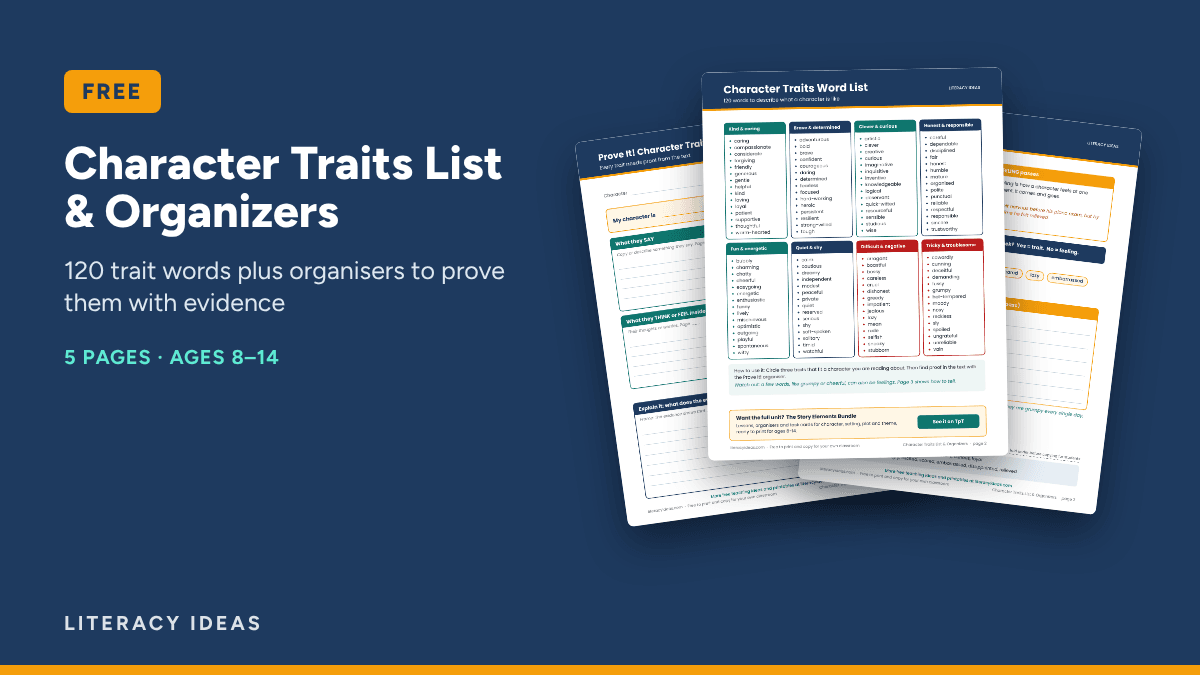
Get the printable character traits list
FREE: Character Traits List & Organizers. A 120-trait word list in 8 groups, a trait or feeling sort with an answer key, a “Prove it!” evidence organiser and a character comparison organiser. 5 print-ready pages for ages 8 to 14: a desk reference and three lessons ready to go. Pop in your email and the download link appears straight away.
How to infer character traits: say, do, think, others
Authors rarely tell us “Tom was selfish.” They show us, and readers have to work it out. That’s inference, and it’s easier for students when they know where to look. I teach four places:
- Say: What does the character say, and how do they say it?
- Do: What do they do, especially when it’s hard or no one is watching?
- Think: What do we learn from their thoughts or private feelings?
- Others: What do other characters say about them, or how do others react to them?
A worked example
Here’s a short invented passage I use with classes. Read it aloud first, then hunt for clues together.
The rain had turned the playing field into a swamp, and the last bus had already gone. Marta could have rung her mum and waited inside. Instead, she stayed by the gate with Jonah, the new boy, who stood clutching a phone with a cracked, dead screen.
“You can use mine,” she said, holding it out before he could ask. “Ring whoever you need. I’m not going anywhere.”
Inside, she was worried she’d miss dinner and get into trouble. But she pictured Jonah standing alone in the dark and pushed the thought away.
When Jonah’s dad finally pulled up, he wound down the window. “You’re the girl who waited? Jonah said you’d stick around. He said you always do.”
Now the worked example, using the four places to look:
| Clue from the text | Where we found it | Trait | Why |
|---|---|---|---|
| “You can use mine… before he could ask.” | Say | generous, considerate | She offers help before she’s asked, so she’s thinking about his needs. |
| She stays by the gate instead of waiting inside. | Do | loyal, dependable | She chooses to be uncomfortable so he isn’t left alone. |
| She’s worried about trouble but pushes the thought away. | Think | selfless, brave | She feels worried (a feeling) but acts anyway, which shows what she’s like underneath. |
| “He said you always do.” | Others | dependable | The word “always” tells us this is a pattern, not a one-off. |
Point out the third row to your class. Marta feels worried, but that’s not her trait. Her trait is revealed by what she does despite the worry. That’s the moment most students finally get the difference.
From the table, a student can write a proper trait statement: Marta is dependable. When Jonah’s phone dies, she waits with him in the rain instead of going inside, and his dad says Jonah told him “you always do.” The word “always” shows this is how she usually behaves, not just a one-time choice.
A 4-lesson teaching sequence for character traits
Lesson 1: Trait or feeling?
Write 16 words on cards, half traits and half feelings. In pairs, students sort them into two piles and must justify each choice using the “usually” test. Finish by matching each feeling to a trait it might grow into (scared → timid). The free pack includes a ready-made 12-word trait or feeling sort with an answer key if you want a quicker version.
Lesson 2: Building precise vocabulary
Take a weak word like “nice” and build a word ladder with the class: nice → kind → considerate → compassionate. Then do “brave”: brave → bold → daring → reckless. Talk about how the last word in each ladder changes the meaning. Students then swap every “nice”, “mean” and “good” in a short paragraph for a more precise word from the list.
Lesson 3: Prove it
Using your class novel or a picture book, students choose one trait for a character and find three pieces of evidence, ideally from at least two of say, do, think and others. They record each clue and explain it. Any of the reading activities for any book pair well with this if you want a follow-up task.
Lesson 4: Compare and create
Students compare two characters (often the main character and the villain) on a comparison organiser, then write a paragraph explaining one key difference. To close the loop, they invent a character of their own, choose two traits, and write a short scene that shows those traits without naming them. That’s a natural bridge into writing great characters and, later, full narrative writing.
Want the full unit? My Story Elements Bundle covers character, setting, plot and more with ready-to-teach lessons and organisers that work with any book you are reading.
Common mistakes students make (and quick fixes)
- Naming a feeling instead of a trait. “Sam is angry.” Fix: ask “Is he angry all the time, or just here?” If it’s just here, find the trait underneath.
- Using vague words. Nice, good, mean and bad tell the reader almost nothing. Fix: ban them for a week and keep the trait list on desks.
- Describing appearance. “She is tall and has red hair.” Fix: use the “usually” test from earlier.
- Giving one piece of evidence. One action could be a one-off. Fix: require at least two clues from different places.
- Retelling instead of explaining. Students copy the event but never say how it shows the trait. Fix: give them the sentence starter “This shows she is… because…”
- Forgetting that traits can change. Fix: track one character’s traits at the start, middle and end of a book and ask what caused the change.
Character traits FAQ
How many traits should students identify for one character?
Two or three well-proven traits beat a list of ten. For younger students, one trait with two clues is a great goal. Older students should aim for two contrasting traits, such as brave but reckless, because that’s where interesting characters live.
Can a character trait be both positive and negative?
Yes, and it’s worth teaching. Words like stubborn, cautious, competitive and sensitive can help or hurt a character depending on the situation. Ask students to find a moment where the trait helps and one where it causes trouble.
What’s the difference between a character trait and a motive?
A trait is what a character is like. A motive is what they want and why. A greedy character (trait) might steal the treasure because they want to be the richest person in town (motive). The two work together to explain behaviour.
How do I teach character traits to younger students?
Start with picture books, where pictures carry lots of clues. Use a small set of 10-15 trait words, act them out, and stick to “say” and “do” before adding “think” and “others”. The simple trait list and sort in the free pack are pitched for this.
Do main characters always change their traits?
Not always, but often. Many stories are built around a character who starts selfish and ends generous, or starts timid and ends brave. If a trait changes, ask students to find the event that caused it. That usually points straight to the story’s theme.