


A good graphic organizer does one job: it gets the story out of a student’s head and onto paper in an order they can actually write from. The wrong organizer, or the right one at the wrong time, just becomes another worksheet to fill in.
Below you’ll find the six narrative writing graphic organizers I used most in the classroom, when to use each one, how to model them, and how to get students from planner to draft. They’re all in one free printable pack, including a filled-in model. If you want the complete guide to teaching stories from start to finish, head to my narrative writing guide.
Which narrative graphic organizer to use when
Not every story needs every organizer. Pick the one that matches where your students are stuck.
| Organizer | Use it when… | Best for |
|---|---|---|
| Brainstorm web | Students say “I don’t know what to write about” | Generating and choosing an idea |
| Character profile | Characters are flat or just names | Building a main character with a want, a fear and a change |
| Setting sensory map | Stories happen “nowhere” | Describing a place with all five senses |
| 5-stage plot map | Stories ramble or stop suddenly | Shaping orientation, complication, climax, resolution and ending |
| Scene planner | Stories skip from the start to the end | Planning the beginning, middle and end with events, feelings and one vivid detail each |
| Simple planner | Younger or reluctant writers are overwhelmed | Beginning, middle and end in three boxes with picture space |
A quick note on each
- Brainstorm web: Students jot quick notes in each box (who, where, when, the problem, what the character wants and how it might end), use a “What if…?” spark if they’re stuck, then sum up their best idea in one sentence.
- Character profile: Go beyond hair colour. The key boxes are what they want, what they fear and how they change from the start of the story to the end. My guide to writing great characters and settings goes deeper.
- Setting sensory map: One box for each sense. Students who fill in “smell” and “sound” always write richer settings than those who only fill in “see”.
- 5-stage plot map: The workhorse. It makes the story elements visible and stops the classic “and then I woke up” ending.
- Scene planner: Beginning, middle and end, each with what happens, how the character feels and one vivid detail. The end row is where the big moment sits, so students can’t skip it.
- Simple planner: Three picture boxes, each with a few lines and a sentence starter. Perfect for younger students or anyone who freezes at a full page.
Download the narrative writing graphic organizer pack
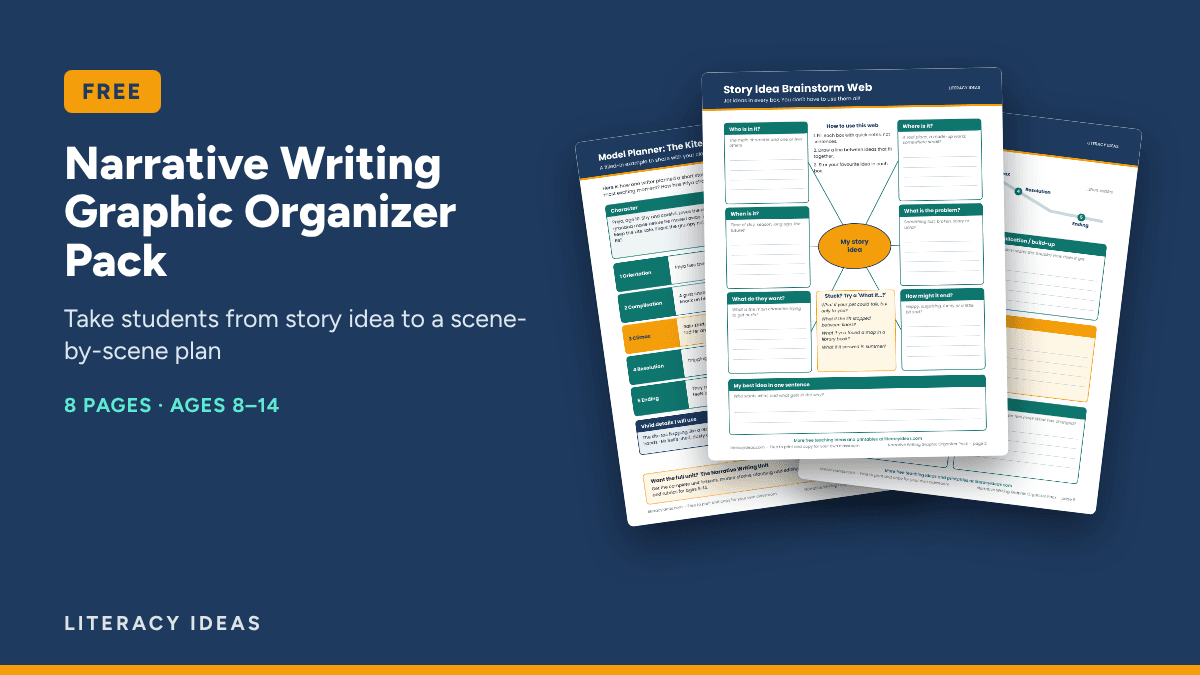
FREE: Narrative Writing Graphic Organizer Pack. Teacher notes plus 7 printable pages: brainstorm web, character profile, setting sensory map, 5-stage plot map, scene-by-scene planner, a simple planner for younger writers, and a filled-in model to show your class. Ages 8 to 14. Pop in your email and the download link appears straight away.
How to model a graphic organizer with the class
If you hand out an organizer without modelling it, you’ll get one-word answers. Here’s the routine that worked for me.
- Plan your own story live. Project the blank organizer and think aloud as you fill it in. Let students hear you change your mind: “Actually, losing a dog is a stronger problem than losing a hat.”
- Write in notes, not sentences. Show that a planner uses dot points and key words. This keeps it fast and stops students writing the whole story on the planner.
- Invite the class in. Let students suggest the complication or the ending. Shared ownership keeps them engaged.
- Show the finished model. Leave your completed planner up while students do their own. The filled model in the free pack is there for exactly this.
Here’s a snippet of a modelled 5-stage plot map for an invented story, The Kite on the Roof:
- Orientation: Leo, windy afternoon, brand new red kite, park near his flat
- Complication: String snaps, kite lands on the roof of the old library. Leo tries a long stick (too short), asks a grumpy caretaker (says no), wind picks up
- Climax: Caretaker sees Leo about to climb the bins, sighs, fetches his ladder
- Resolution: Kite rescued; caretaker admits he used to fly kites
- Ending: They fly it together, and Leo decides grumpy people deserve a second chance
Moving from planner to draft
This is where many students stall. The planner is full, but the draft doesn’t follow it. Try these steps:
- One box, one paragraph. On the plot map, each stage becomes at least one paragraph. Students tick each box as they write it.
- Turn notes into sentences aloud first. Pairs “tell” their story to each other using only the planner. If they can tell it, they can write it.
- Stretch the climax. Students use the end row of their scene planner, where the big moment sits, and make the climax the longest part of the story.
- Keep the planner beside the draft. Not in the tray, not in the bag. On the desk, every lesson, until the draft is done.
For personal stories rather than invented ones, the planning is slightly different. See my guide to writing a personal narrative.
Want the full unit? My Narrative Writing Unit takes students from first idea to polished story, with model texts, lessons and checklists. I built it from years of teaching narrative in my own classroom.
Narrative graphic organizers FAQ
Which graphic organizer is best for narrative writing?
For most students aged 8-14, the 5-stage plot map gives the biggest improvement because it fixes structure. Add the character profile or setting map when you’re working on description, and use the simple planner for younger writers.
Should students use more than one organizer per story?
Older students can use two or three across a unit, such as a brainstorm web, then a plot map, then a scene planner. Younger students do best with one. Too many planners and the writing never starts.
How long should planning take?
Usually one lesson, or about 20-30 minutes for a short story. If planning drags across several lessons, students lose energy before they write a word. The plan should be quick notes, not polished sentences.
What if a student wants to change their story while drafting?
Let them, as long as they update the planner. Changing direction is what real writers do. The rule is simply that the new version still needs a clear problem and a resolution.
Can I use these organizers for retelling a story we’ve read?
Yes. The plot map and character profile both work well for retelling and analysing class novels. It’s a great way to show students how published authors structure stories before they plan their own.
Want the full teaching sequence, model texts and lesson ideas? Read the complete narrative writing guide.