


The week before a holiday is not the week for introducing a brand new text type. Students are excited, routines wobble, and attention spans shrink. What you need is writing that feels like fun but still practises real skills.
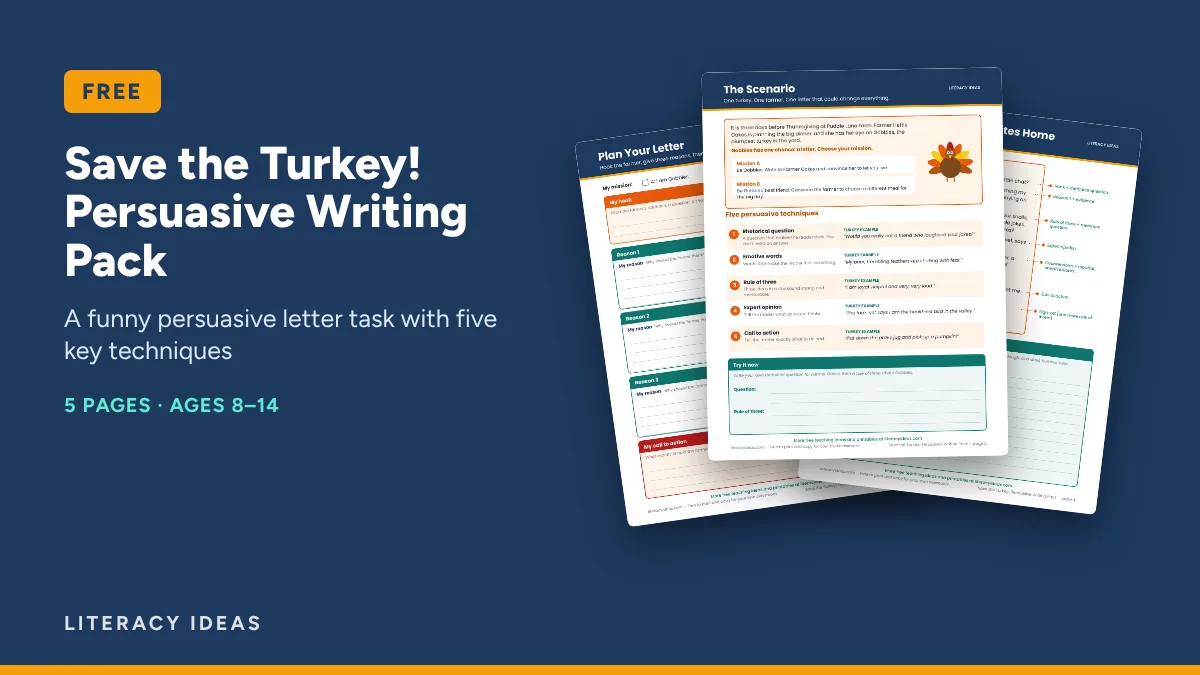
The “Save the Turkey” persuasive letter is my favourite answer. Students write to a family begging them to serve something else for the Thanksgiving feast. It’s silly enough that everyone wants to join in, and serious enough that you can teach reasons, evidence and persuasive language properly. Below is the full activity step by step, a model excerpt, six more Thanksgiving writing prompts, and a free printable pack.
The Save the Turkey persuasive letter, step by step
Step 1: Set up the problem
Tell students that a turkey on a farm has just discovered it’s on the menu. It needs help. Students can write as the turkey itself, or as a friend speaking up for it. Decide as a class who the letter is to: the farmer, the family cooking the feast, or the town mayor.
Step 2: Brainstorm reasons
In pairs, students list every reason the turkey should be saved. Push for variety: reasons about the turkey (it’s the farm’s best alarm clock), reasons about the family (a vegetable feast is healthier) and reasons about everyone (tradition can change). Then choose the three strongest.
Step 3: Add persuasive techniques
Introduce or revise a few persuasive writing techniques: a rhetorical question, an emotional appeal, a “fact” (silly ones allowed), and a call to action. Students tag where each one could go in their letter.
Step 4: Plan the letter
Use a simple structure: greeting, opening statement, three reasons (one paragraph each), a counter-argument (“You might say turkey is tradition, but…”), a closing call to action, and a sign-off. If your students need a refresher on layout, my guide to writing a great letter covers it.
Step 5: Draft, share and vote
Students draft, then read their letters aloud to a small group. Each group picks the most persuasive letter and explains why. Display the winners on a “Turkeys Saved” wall.
Planning persuasive writing lessons from scratch takes time. If you’d rather start with something ready, our Opinion Writing Unit has a month of lessons, organisers and prompts ($9.95 on TpT).
Model excerpt
Here’s an invented excerpt I share with classes as a model. Read it once for fun, then again to spot the techniques.
Dear Mr and Mrs Patterson,
My name is Gerald, and I am the turkey who lives behind your shed. I am writing because I have heard some very worrying news about your Thanksgiving menu.
Firstly, who will wake you up if I am gone? Every morning at six o’clock I gobble outside your window, free of charge. Do you really want to go back to that beeping alarm clock?
Secondly, your children love me. Little Daisy has named me, drawn me, and once tried to teach me to dance. Imagine telling her that her best feathered friend is now the main course.
You might say that turkey is a tradition. But traditions can change. A giant vegetable pie would be colourful, delicious and much less likely to look at you with big, sad eyes.
Please, I am begging you, choose the pie. Save Gerald.
Yours hopefully, Gerald
Ask students to find the rhetorical question, the emotional appeal, the counter-argument and the call to action. Then ask which reason they’d make stronger.
Want the full unit? Keep the persuasive momentum going after the holiday. My Opinion Writing Unit has a month of persuasive writing lessons, prompts, organisers and anchor charts.
6 more Thanksgiving writing prompts
- A gratitude letter. Write a letter to someone who has helped you this year, explaining exactly what they did and why it mattered. Specific is better than general: “You helped me with long division at lunchtime” beats “You’re nice.”
- A recipe procedure. Write the steps for a favourite family dish, real or invented. Include a list of ingredients, numbered steps and bossy verbs (stir, pour, chop). Great for practising procedural writing.
- The great turkey escape. Write a short narrative about a turkey who escapes the farm the night before the feast. Where does it hide, and who’s chasing it?
- Describe the feast. Write a paragraph that describes a festive table using all five senses. Challenge: no use of “yummy”, “nice” or “good”.
- A thankful list poem. Write a poem where every line starts with “I am thankful for…” Push students to move from big things (family) to tiny things (the first warm sip of hot chocolate).
- Opinion: the best side dish. Which side dish deserves the top spot on the table, and why? Give three reasons. A short, low-stakes way to practise opinion writing.
Need more quick-win ideas for busy weeks? Try these fun writing activities for students.
Thanksgiving writing FAQ
What age is the Save the Turkey letter best for?
It works across ages 8-14. Younger students can write three short reasons with sentence starters. Older students should add a counter-argument, stronger evidence and a deliberate range of persuasive techniques.
How long does the activity take?
Plan for two to three lessons: one for brainstorming and techniques, one for drafting, and an optional third for editing, sharing and voting. A shorter version fits into a single double lesson.
What if some of my students don’t celebrate Thanksgiving?
The activity works as a general persuasive task about any festive meal. Students can write to save a turkey, a chicken, a fish or even a pudding from any celebration they know. The persuasive skills are the same.
How do I assess a fun persuasive letter?
Focus on three things: is the position clear, does each reason have an explanation, and is there a call to action at the end? A short checklist keeps marking quick and gives students clear targets.