


A passion project is a self-directed project in which a student chooses something they want to learn or make, works on it over several weeks, and then shares what they learned, including what went wrong. It might be baking bread, coding a game, learning a magic routine or running a fundraiser. The topic belongs to the student; the teacher provides the structure.
This guide explains how passion projects work, how they differ from genius hour and project-based learning, and how to run one in your classroom. It includes 50 passion project ideas, an eight-week timeline, assessment tips and a free starter kit.
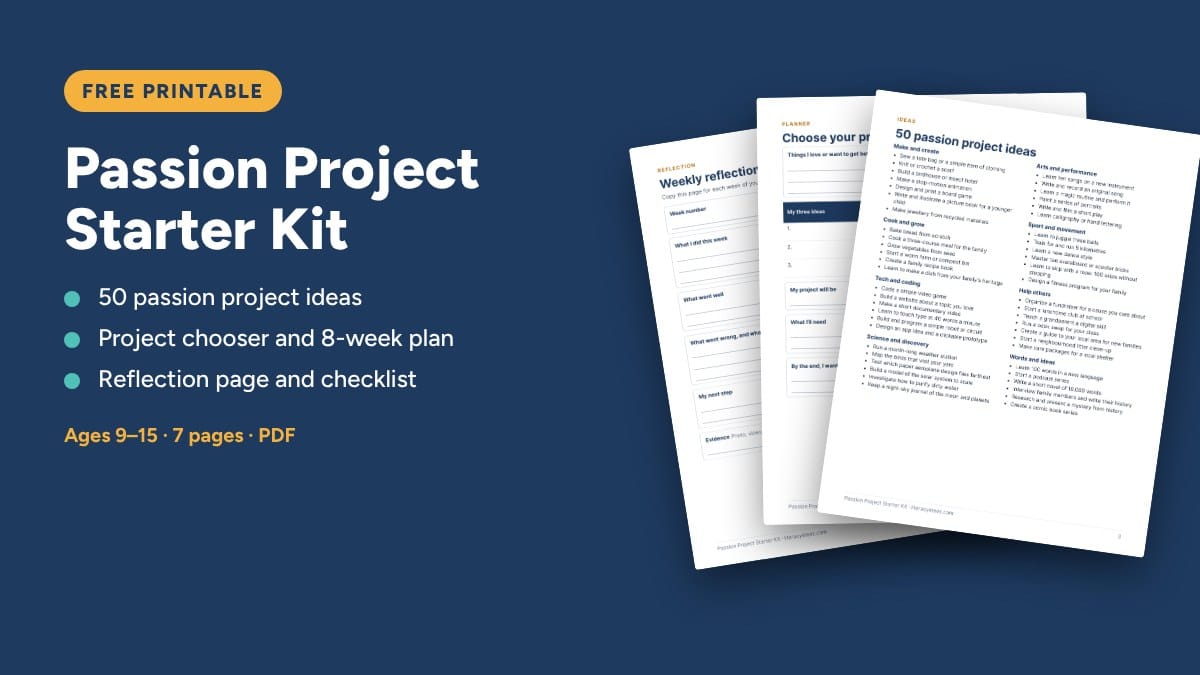
Free Passion Project Starter Kit
FREE: Passion Project Starter Kit. A guide to the six steps, 50 project ideas, a project chooser, an eight-week plan, a weekly reflection page and a presentation checklist. 7 print-ready pages. Pop in your email and the download link appears straight away.
What Is a Passion Project?
In a passion project, students pick a skill or product they are curious about, set a goal, and spend six to twelve weeks working towards it. Along the way they keep a record of their progress, and at the end they present the journey to an audience.
What makes it different from an ordinary assignment is choice. Students decide what to learn, how to learn it and how to show it. That ownership is the engine: a student who chose to learn guitar will practise at home without being asked, in a way they rarely will for a set task.
A good passion project has four qualities:
- It is new to the student. Something they can’t yet do, so there is real learning to show.
- It is achievable in the time. “Learn ten songs on the ukulele” fits eight weeks; “become a professional musician” doesn’t.
- It produces something to show. A product, a performance, a demonstration or a record of progress.
- It is safe and approved. An adult at home knows about it and agrees.
Passion Project vs Genius Hour vs PBL
These terms overlap, and many teachers use them interchangeably. The differences are mostly about time and how open the brief is.
| Passion project | Genius hour | Project-based learning (PBL) | |
|---|---|---|---|
| Who chooses the topic? | The student | The student | Usually the teacher sets the problem or question |
| When does it happen? | Over 6–12 weeks, often partly as homework | A set time each week in class, often around an hour | A unit of work, often across several subjects |
| Main goal | Learn a new skill or make something | Explore curiosity and inquiry | Solve a real problem or answer a driving question |
| Ends with | A presentation of the journey | A share or presentation | A public product or presentation |
In practice, many teachers run a passion project during genius hour: the weekly time slot is genius hour, and the project students work on in it is their passion project.
Why Passion Projects Work
- Motivation comes built in. Students work hardest on things they chose.
- They teach how to learn. Planning, researching, practising and adjusting are skills students use in every subject.
- Failure becomes useful. Recording what went wrong, and what they changed, teaches resilience better than any poster about growth mindset.
- They connect school and home. Families see what their child cares about, and often get involved.
- Every student can succeed. Projects are judged on effort, learning and reflection, not on talent or starting point.
How to Run a Passion Project: 6 Steps
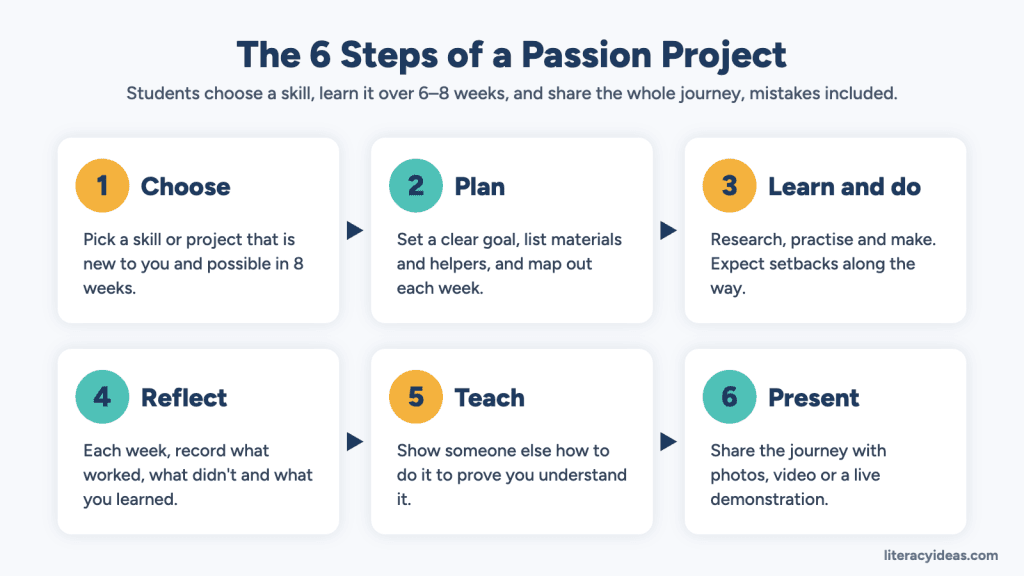
1. Choose
Students brainstorm things they love or want to get better at, then test their top three ideas: is it new to me, can I do it in eight weeks, and can I show it? Approve each choice before students move on.
2. Plan
Students set a specific goal (“bake a loaf of bread that rises”, not “learn to cook”), list what they need and who can help, and break the project into weekly steps. Send a letter home so families know what’s coming.
3. Learn and do
Students research, practise and make. Expect things to go wrong: a cake that sinks, code that won’t run. That is where most of the learning happens.
4. Reflect
Each week, students record what they did, what went well, what went wrong and what they will do next. Photos, videos and sketches make the record far richer.
5. Teach
Students teach their new skill to a classmate or family member. Explaining it shows whether they really understand it, and gives them a confidence boost.
6. Present
Students share the whole journey with the class: where they started, what they can do now, what went wrong and what they learned. Classmates give feedback.
50 Passion Project Ideas for Students
Use these to get students thinking, not as a menu. The best projects usually come from a student’s own interests, so encourage them to change any idea to suit themselves.
Make and create
- Sew a tote bag or a simple item of clothing
- Knit or crochet a scarf
- Build a birdhouse or insect hotel
- Make a stop-motion animation
- Design and print a board game
- Write and illustrate a picture book for a younger child
- Make jewellery from recycled materials
Cook and grow
- Bake bread from scratch
- Cook a three-course meal for the family
- Grow vegetables from seed
- Start a worm farm or compost bin
- Create a family recipe book
- Learn to make a dish from your family’s heritage
Tech and coding
- Code a simple video game
- Build a website about a topic you love
- Make a short documentary video
- Learn to touch type at 40 words a minute
- Build and program a simple robot or circuit
- Design an app idea and a clickable prototype
Science and discovery
- Run a month-long weather station
- Map the birds that visit your yard
- Test which paper aeroplane design flies furthest
- Build a model of the solar system to scale
- Investigate how to purify dirty water
- Keep a night-sky journal of the moon and planets
Arts and performance
- Learn ten songs on a new instrument
- Write and record an original song
- Learn a magic routine and perform it
- Paint a series of portraits
- Write and film a short play
- Learn calligraphy or hand lettering
Sport and movement
- Learn to juggle three balls
- Train for and run 5 kilometres
- Learn a new dance style
- Master ten skateboard or scooter tricks
- Learn to skip with a rope: 100 skips without stopping
- Design a fitness program for your family
Help others
- Organise a fundraiser for a cause you care about
- Start a lunchtime club at school
- Teach a grandparent a digital skill
- Run a book swap for your class
- Create a guide to your local area for new families
- Start a neighbourhood litter clean-up
- Make care packages for a local shelter
Words and ideas
- Learn 100 words in a new language
- Start a podcast series
- Write a short novel of 10,000 words
- Interview family members and write their history
- Research and present a mystery from history
- Create a comic book series
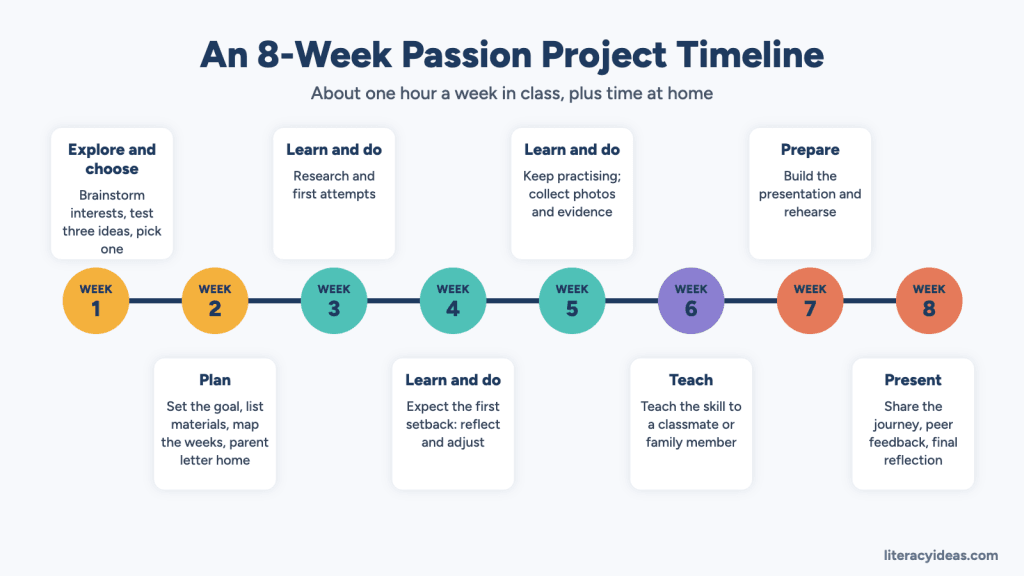
An 8-Week Passion Project Timeline
| Week | Focus | What students do |
|---|---|---|
| 1 | Explore and choose | Brainstorm interests, test three ideas, choose one and get it approved |
| 2 | Plan | Set a goal, list materials and helpers, plan each week, take the letter home |
| 3–5 | Learn and do | Research, practise and make; weekly reflection and evidence |
| 6 | Teach | Teach the skill to someone else and record how it went |
| 7 | Prepare | Build the presentation and rehearse |
| 8 | Present | Present to the class, give peer feedback and write a final reflection |
For a longer unit, stretch “learn and do” to six or eight weeks. For a shorter one, combine weeks 6 and 7.
How to Assess a Passion Project
Assess the process, not the product. A student whose bread never rose but who can explain exactly why, and what they changed each time, has learned more than one who got it right first time.
- Planning: a clear, realistic goal and a weekly plan.
- Effort and persistence: evidence of steady work, especially after setbacks.
- Reflection: weekly entries that explain what happened and why.
- Teaching: evidence that the student taught the skill to someone else.
- Presentation: a clear account of the journey, with evidence.
Peer feedback works well at the presentation stage. Give students two or three specific things to look for, such as “Did they explain a mistake and what they learned?”
Common Problems and How to Fix Them
| Problem | What to do |
|---|---|
| “I don’t know what to do.” | Start with what they do outside school, or give them the ideas list and ask them to choose three to cross out first. |
| The project is too big | Shrink the goal, not the topic: “build a robot” becomes “build a buggy that follows a line”. |
| Motivation drops in weeks 3–4 | Normal. Share reflections about setbacks, set a mini-goal for the week, or bring the “teach someone” step forward. |
| The student wants to switch projects | Only in week 1 or 2. After that, help them adjust the goal instead. |
| Unequal support at home | Give class time each week and keep materials simple. Choose projects that need time rather than money. |
| A parent does the project | Make the weekly reflection and the “teach someone” step the core of the grade. Both have to come from the student. |
Want the whole unit done for you? The Passion Project Unit is a complete 8–12 week project for grades 4–9, with teacher and student instructions and examples, editable letters to parents, timelines, learning journals, thinking tools and assessment tools. Rated 4.63 from 259 teacher reviews.
Frequently Asked Questions
What is a passion project for students?
A self-chosen project in which a student learns a new skill or makes something over several weeks, records their progress, and presents what they learned to an audience.
How long should a passion project take?
Most run for six to twelve weeks. Eight weeks gives enough time to learn something new without students losing interest.
What age are passion projects suitable for?
Upper primary to middle school (roughly ages 9 to 15) is the sweet spot, but they work at any age with the right amount of structure.
What is the difference between a passion project and genius hour?
Genius hour is regular class time set aside for student-led learning. A passion project is a specific project students complete, often during genius hour.
How do you grade a passion project?
Grade the process: planning, persistence, reflection, teaching the skill to someone else and the final presentation, rather than how impressive the final product is.
Related guides: Research strategies for students · How to search Google like a pro · How to write a recount (for reflection journals) · Writing and journal prompts