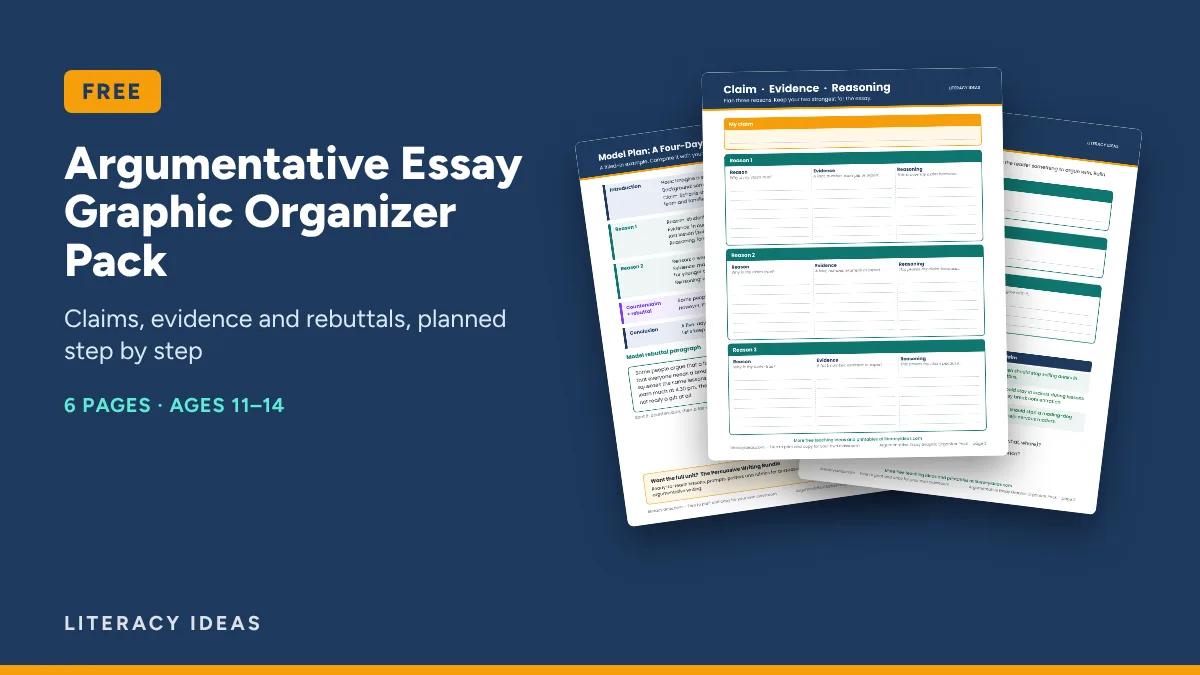
Free Argumentative Essay Graphic Organizer Pack (PDF)

Ask a class to “write an argument” and you’ll usually get one of two things: a single paragraph that says “I think school uniforms are bad because they are bad”, or three pages of opinions with no order at all. Neither is a lack of ideas. Students almost always have strong views. What they’re missing is a structure that shows them where each idea goes.
That’s what this free graphic organizer pack is for. I first shared a version of it years ago, and teachers have downloaded it ever since. I’ve now rebuilt it from scratch so it’s clearer, more flexible and better suited to older students, aged about 11-14.
Planning argumentative writing lessons from scratch takes time. If you’d rather start with something ready, our Opinion Writing Unit has a month of lessons, organisers and prompts ($9.95 on TpT).
An argumentative essay has a few moving parts, and each organiser in the pack deals with one of them:
- The claim. Students write their position in one clear sentence before they do anything else. If they can’t say it in a sentence, they’re not ready to write.
- Reasons and evidence. Each of three reasons gets its own row, with space for evidence (a fact, number, example or expert) and the reasoning that links it to the claim. This is where weak arguments get strong.
- The other side. Older students in particular need to show they’ve considered the counter-argument, then explain why their view still holds. The rebuttal page walks them through it.
- The essay map. Finally, everything slots into a five-paragraph outline: introduction, two reasons, the counterclaim and rebuttal, and a conclusion. Students write from this map, one box at a time. A filled-in model plan shows them what a finished one looks like.
A tip from my own classroom: don’t start with a serious topic. Start with something students already argue about at lunchtime, like whether homework should exist or which is the best pet. Once the structure clicks with an easy topic, move to a meatier one. The skills transfer, and the confidence comes with them.
If you’d like more on the techniques that make arguments convincing, read my guide to persuasive writing techniques for students, or see how to teach persuasive essays step by step.